The Cost of Discretion
Why I stopped manual trading after seven years (and what I wish I'd done sooner).
- After seven years of manual trading, I switched to a fully systematic approach in 2024.
- The decision came down to reproducibility, capacity, and the realisation that "edge" and "good days" are two completely different things.
- Discretionary trading punishes you for the parts of your brain that it is incredibly difficult to rewire. Systematic trading lets you remove those parts from the loop.
- If you are early in your journey, the cost of delaying the switch is probably higher than you think.
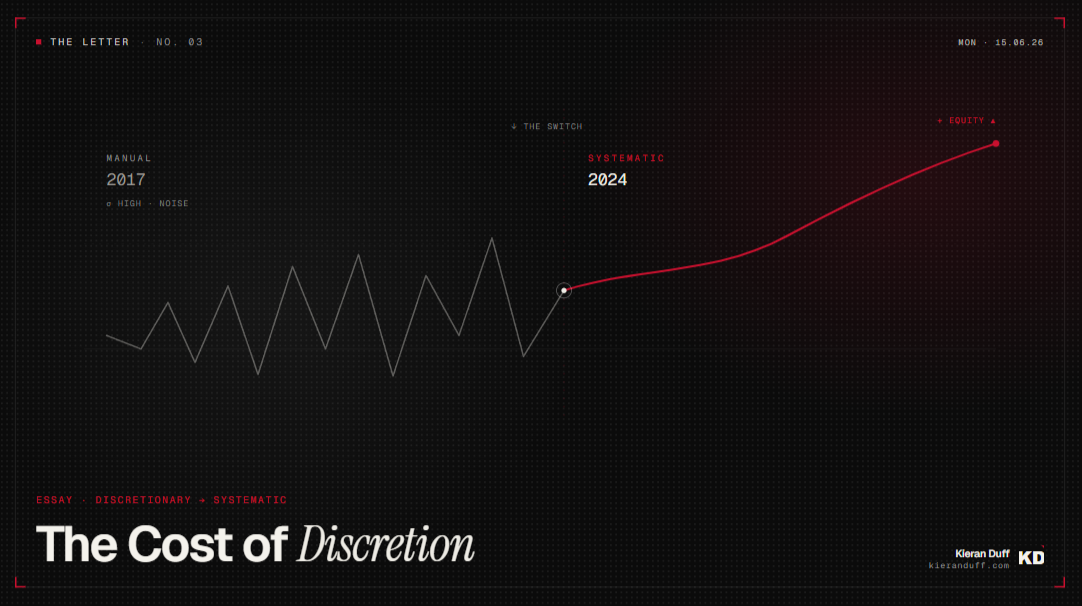
I traded discretionary for seven years before I stopped. Not because I blew up. Not because I had some "breakthrough" moment of clarity in a coffee shop. I stopped because I finally did the maths on what those seven years had actually cost me, and for me the answer was uncomfortable.
This is not a "systematic is better than discretionary" piece. Social media has enough of those, mostly written by people who have done neither at any scale. This is a practitioner walk-through of why the manual approach did not suit me (I wrote a shorter version earlier), what cognitive holes I tried (and failed) to patch, and how I'd rebuild the same seven years if I had to start over today.
The seven years of manual trading I spent learning the wrong lesson
I started trading manually in 2017. Standard retail journey: a few books, a TradingView account, a small live account. Within two years I had a strategy I genuinely believed in, an FX-majors swing model built on multi-timeframe structure with a discretionary trigger and a hand-managed exit (credit to Tom Dante for being a huge early inspiration of mine, and putting me on the right path).
By year four I was profitable. Not life-changing, but profitable.
Here is the part I got wrong for years: I thought the profitability was the lesson. It was not.
If your discretionary process is genuinely repeatable, it is probably more systematic than you think. The only question is whether you let a machine run it for you or you keep running it yourself for no good reason.
What manual trading actually felt like in week 320
People who have never done it imagine discretionary trading as a series of interesting decisions: read the chart, weigh the evidence, pull the trigger. The reality, once the strategy is mature, is grinding.
Week 320 looked like this. Up at 5:45. Pre-market read across the FX block, the index futures, gold and silver. Watch for the London open. Identify three or four setups that fit the model. Wait for confirmation. Execute, set the stop, set the target, walk to make a coffee with one eye on the phone. Manage. Close. Repeat. Write it up in the journal. Tag the screenshot. Move on.
The decision-making part was maybe two percent of the time. The other ninety-eight percent was vigilance. Sitting in front of the screen during the hours my model was active, because if I was not there, I missed the setup. Days I needed to focus elsewhere; days my kids were unwell, days I was simply tired, all of them ate into the same fixed capacity.
That is the bit nobody tells you about manual trading: the bottleneck is not your edge, it is you.
The four cognitive holes you cannot patch with discipline
I spent years trying to fix the holes with discipline.
The holes are these:
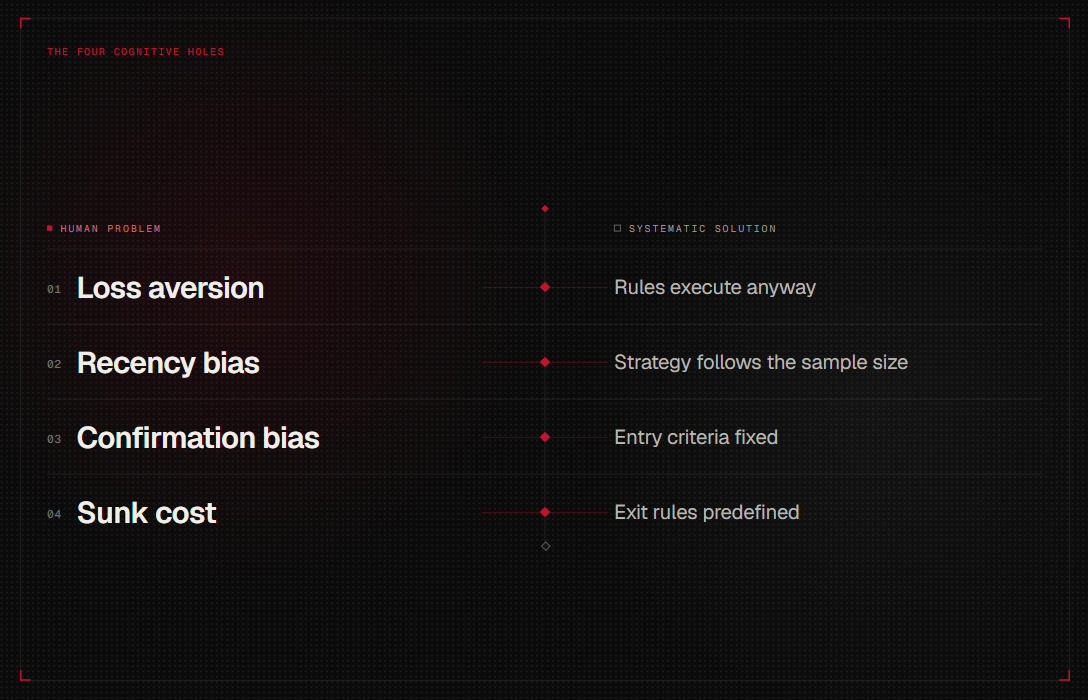
Loss aversion. A losing trade hurts roughly twice as much as a winning trade of the same size feels good. This is well-documented, well-quantified, and it does not go away because you read about it. After three losses in a row, even a strategy you have tested across thousands of trades will start to feel broken. Manually executing the next trade in the sequence is fighting your own brain stem.
Recency bias. The last ten trades feel more representative of the strategy than the previous five hundred. You will sample-size yourself into changing the rules during a normal drawdown. I have done it. Every discretionary trader I know has done it.
Confirmation bias. Once you have a thesis on a setup, every piece of evidence on the chart starts to point toward it. The clean rule you wrote down at 6am gets bent by 9am because the market is "almost giving you the signal".
Sunk cost. A trade that is half-stopped looks different at the half-stop than it did before you entered. Holding through pain because "I've already given it this much room" is the same logic that keeps people in failing relationships and bad jobs.
You cannot discipline your way out of these holes. You can manage them, you can build awareness around them, you can keep them within tolerances. What you cannot do is remove them. The only thing that removes them is taking the human out of the execution loop.
Why "good days" are the trap, not the reward
This is the part I most want anyone reading to take seriously.
A good "discretionary day", by which I mean a day where you took three setups, all three worked, and you closed up two or three R, is the most dangerous data point in your career. The day itself was fine. The danger is what it teaches you.
It teaches you that the version of yourself that made those decisions is the real version. The next time you have a tough call, your mind will reach for that version. The version who saw clearly, who pulled the trigger without hesitation, who managed the exit perfectly. The trouble is, the version who showed up on Tuesday is not the same version who shows up on Friday after a poor night's sleep, with a child off school, after a losing morning session.
The variance in your own performance, day to day, is much larger than the variance in your strategy's expected return.
So the days that feel like proof of your skill are mostly proof of your good luck in mood, focus, and external conditions on that specific day.
A systematic strategy does not have good days and bad days in the same sense. It has the day the rules said to take three trades, and the day they said to take none. The output is more boring. As I always say, boring is the point.
The first systematic strategy I built that survived live trading
I started building systematic strategies in late 2024, alongside my manual book. I used FX Dreema for the build environment because it forces you to think about the components, feature, signal, exit, sizing, separately.
My first ten candidate strategies all failed at the first hurdle. I killed them.
The eleventh one survived. It was a structure-based mean-reversion strategy on EUR-crosses with a vol filter and a fixed-fractional sizing rule. It was less profitable in backtest than my manual book had been. That was the moment I knew I had something real.
Why? Because every discretionary trader eventually learns that spectacular backtests and live survival are often negatively related. The strategies that look spectacular in backtest are usually overfit. The ones that look acceptable, robust across parameters, stable across instruments, are the ones that have a chance live.
I ran that strategy alongside my manual book for six months. The output was within tolerance of the backtest. That was all I needed.
What I miss about manual trading (and why I am not going back)
I miss the engagement. I do. There is something specific about watching a trade play out in real time, knowing you read the structure correctly, watching price do what you thought it would do. That dopamine hit is not replicated by checking on a portfolio of automated strategies at the end of the week.
I miss the agency. When the system loses, it loses according to the rules. When I lost manually, at least it was my call. Owning the outcome had a clarity to it that running a portfolio does not.
I miss the simplicity. One screen, one approach, one me. A systematic book is a different operational problem: monitoring strategies for decay, modelling correlation between them, working out which to add and which to retire, building infrastructure to keep it all running. The work changes shape.
I am not going back. The reasons are simple. My systematic book scales, runs while I raise my family, and accommodates twenty-eight strategies across FX, indices and metals. My manual book accommodated me, sat at one screen, on one cluster, for as many hours as I could sustain.
The trade I made was engagement for capacity. That is the trade I would make again every time.
How to make the switch without losing two years
If you are early in your manual trading career, here is the path I would walk if I could go back.
Start systematic alongside manual from year one. Do not treat systematic as a phase-two thing you graduate to. Treat it as the discipline that forces you to write down what your discretionary edge actually is. The act of trying to codify a discretionary strategy into rules will tell you immediately whether the edge is real or whether it lives in your head as a vague pattern recognition.
Use a build environment that exposes the mechanics. There are plenty to choose from and I will not suggest one as each platform suits a different style of trader individually. The whole point of going systematic is to make every component of your edge inspectable.
Backtest, walk-forward, Monte Carlo. In that order. A clean backtest tells you nothing on its own. The walk-forward tells you whether the strategy holds across time periods it was not optimised on. The Monte Carlo distribution of the trade sequence tells you whether your equity curve is robust or whether you got lucky with the ordering.
Run paper or micro-live for three months before scaling. Backtest is theatre, live is real. The variance between the two is the variance you actually need to model.
Do not abandon manual entirely until your systematic book is doing what you need it to do. The crossover is the hardest period. Most people who switch and fail do so because they cut the manual book before the systematic book was carrying its weight.
Be patient with the rebuild. The seven years I spent manual were not wasted. Every one of those years sharpened my read of structure, my feel for vol regime, my discipline around drawdown. All of that fed into the strategies I now build. You cannot skip the seven years. You can, however, decide what you do with them.
Let me answer some questions you probably have
Is systematic trading actually more profitable than discretionary?
In raw return terms, not necessarily. The case for systematic is capacity, reproducibility, and the ability to run multiple uncorrelated strategies simultaneously. A discretionary trader who is profitable on one strategy will struggle to run five. A systematic trader can run twenty-five.
How long does it take to learn systematic trading?
If you already have a working discretionary edge, six to twelve months to codify it into a survivable strategy. If you are starting from scratch, plan on two to three years before your systematic book is doing real work.
Do I need to learn to code to trade systematically?
No, but it helps. Block-builder platforms like StrategyQuantX let you build strategies without coding. Knowing some Python or MQL helps you debug edge cases and inspect the maths the platform is doing for you. Treat coding as a force multiplier, not a barrier.
Can a discretionary trader still make money in 2026?
Yes. The market does not care how you arrived at the decision. What it cares about is whether the decision had positive expected value and survived execution. The reasons to consider switching are operational: scaling, capacity, reproducibility. "Discretionary is dead" is not one of them.
What is the hardest part of the switch from manual to systematic?
Trusting the system through a drawdown the model says is within tolerance. Every discretionary instinct will scream at you to override. The whole point of going systematic is to stop overriding. That dissonance is the actual work of the transition.
The seven years I spent manual gave me the read on markets that lets me build strategies that survive live. I needed every one of them. What I would change, if I could, is what I built with those years. If you have done two of those seven, the maths is roughly in your favour to start building systematic now, in parallel, with whatever discretionary book you have running. The compounding cost of waiting is real.
Thanks for reading.
Kieran
Disclosure. Personal commentary, not financial advice. Capital at risk. I am an employee of Darwinex; content touching Darwinex products may represent a conflict of interest, disclosed per MAR Article 20.
XAQP figures are point-in-time as of May 2026 and will change.
Get the next letter in your inbox.
Please consider subscribing to receive more episodes of The Letter.
Subscribe now