Raising Capital
How to find investors for your trading strategy, where allocator capital actually comes from, and how to operate within the frameworks of the regulator.
- Investors fund verified, live, third-party-auditable track records. Twelve months live is the practical floor, and the trade sample matters as much as the calendar time.
- The capital arrives through four routes: allocation programmes, traditional prop, private agreements, and index or marketplace inclusion. All four check the same record first.
- Deal discipline decides whether the raise is worth having. Not every deal is a good deal, and capacity sold cheap never comes back.
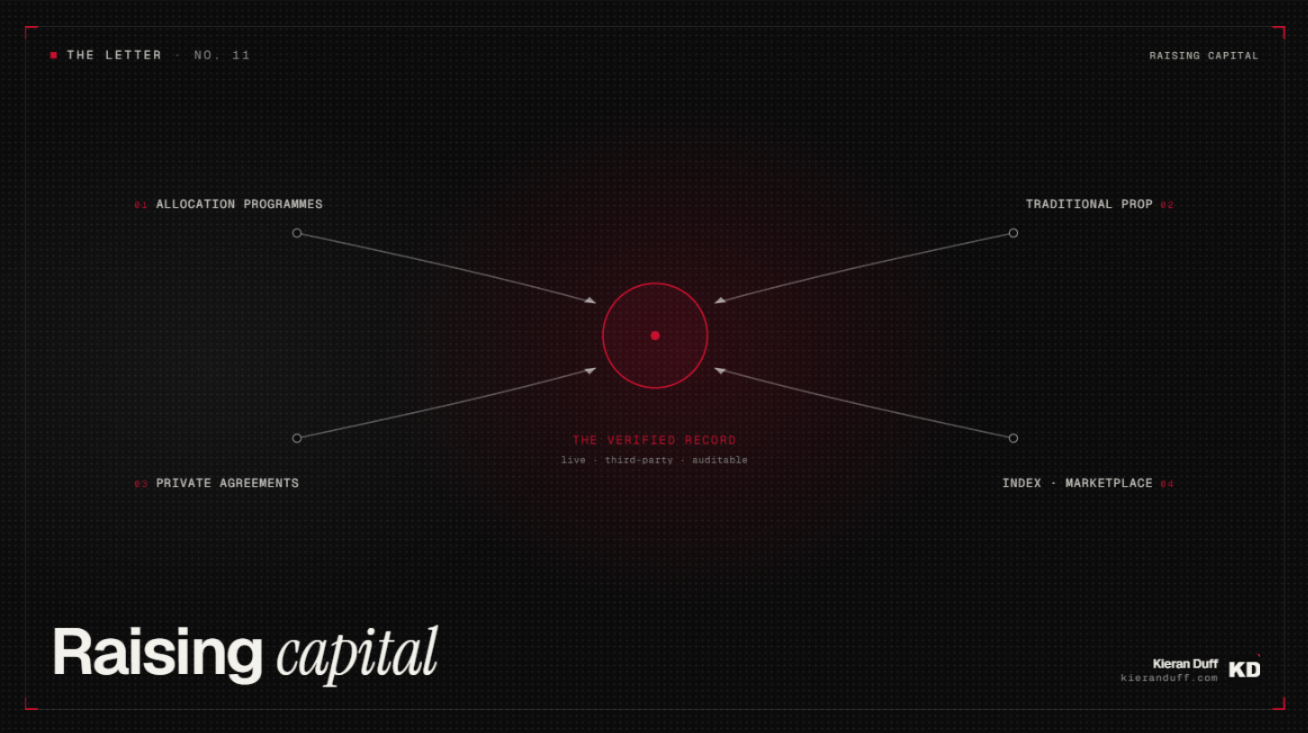
"How do I find investors?" lands in my inbox a lot. Fair enough: I've raised external capital for XAQP through various channels (allocation platforms, boutique fund agreements & INDX), so from the outside it looks like there's a playbook. There is one, and it starts somewhere unfamiliar for most. If you want to find investors for your trading strategy, build the thing capital can verify before you speak to a single investor. The record does the raising. Everything else is logistics.
What do investors actually fund?
A record they can defend to somebody else. Whether it's a seeder, a family office or a platform allocation engine, the person allocating answers to a committee, a boss, or their own post-mortem. The product you're selling is defensibility: a live track record, verified by a third party, with risk numbers attached that survive inspection. Screenshots aren't a track record. A trading journal isn't a track record. A backtest, however careful, isn't one either. Bored of hearing otherwise.
Verification means performance measured at account level by someone with no stake in flattering it (a regulated platform, an administrator, an auditor), risk observable in the data, and no gaps where the bad months should be. My own numbers sit on a public profile I cannot edit. Uncomfortable in a bad week, and worth more than any pitch deck I could write.
How long a track record do you need?
Twelve months of live, verified performance is the practical floor. Below that you're asking an allocator to defend a coin flip to their committee.
Calendar time is only half the bar. The other half is sample: trades across regimes. A year containing 800 trades through trending, choppy and dead markets beats two years containing 90 trades from a single regime. Depth of evidence is what gets defended in the room, and the risk numbers carry more of that weight than the return. Max drawdown, time underwater, stability of the monthly distribution. Returns open the conversation; drawdowns close the deal.
Returns open the conversation; drawdowns close the deal.
My own bridge here: the public record was just under a year old when external capital started arriving, with 8+ years of trading behind it. The earlier years don't show on the profile, but they show in the risk discipline, and that's the part a sharp allocator reads first.
While the record matures, the work is the record. A raise attempted six months early costs more reputation than it gains capital.
Where does the capital actually come from?
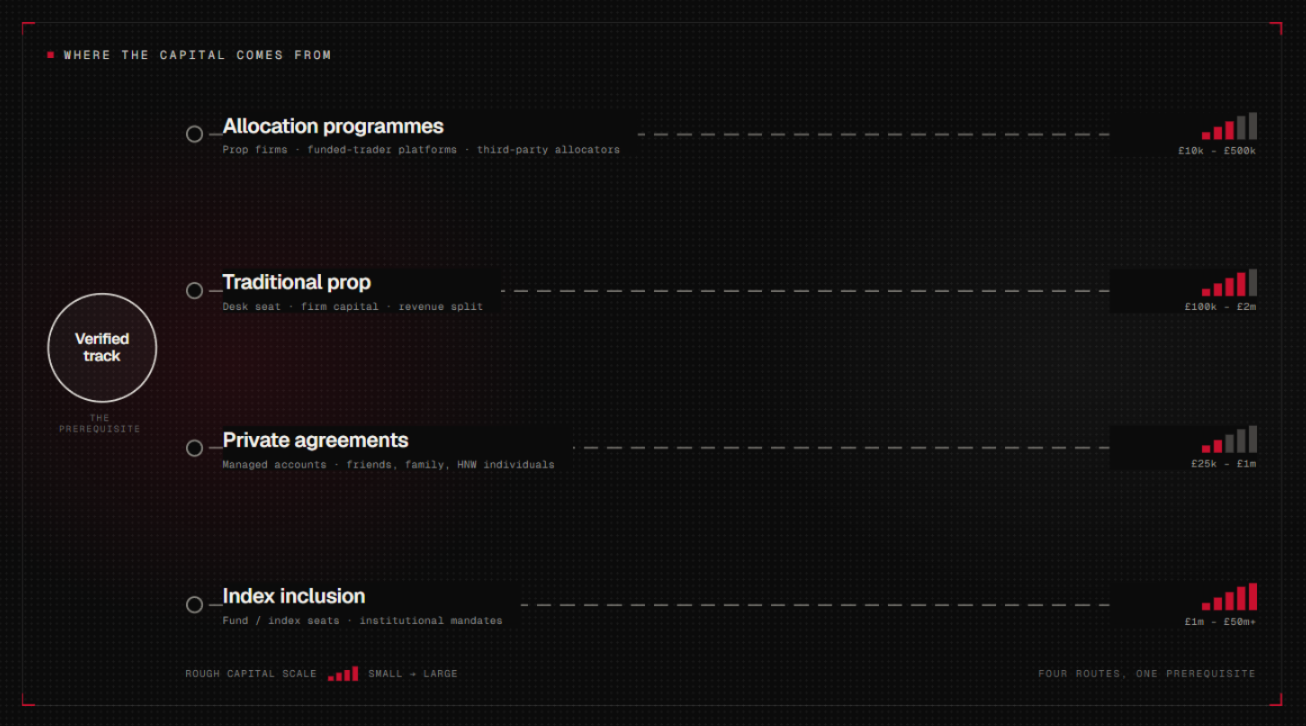
Four routes, and all four check the same record first.
Allocation programmes. Platforms that allocate house or partner capital to traders on merit, against published rules. This was my first external capital: XAQP earned DarwinIA seed allocations at Darwinex Zero through 2025, month by month, before any private investor arrived. Programme capital starts small and is brutal about discipline, which is exactly what makes it valuable: it forces the record into shape while paying you to build it.
Traditional prop. Real prop shops that back traders with firm capital and take a share of performance. A good vehicle for scaling, and a different animal from the online challenge-fee industry. If the firm's revenue comes from your trading, incentives align. If its revenue comes from your sign-up fees, you're the product.
Private agreements. Family offices, boutique funds, individuals with capital who found you through the network. Part of XAQP's capital runs through agreements of this kind alongside the platform. These deals are relationship-led, slow and paperwork-heavy, and they only ever start from a verified record plus a warm introduction.
Index and marketplace inclusion. The compounding route: once a record clears a platform's quality bar, products built on top of it bring capital you never pitched. XAQP entered the Darwinex INDX in February 2026, and allocation has arrived from investors I have never spoken to. You can't apply for that directly. The record either qualifies or it doesn't.
For scale: at the $1M investor-capital crossing in February 2026, XAQP had 33 investors. I had cold-pitched none of them.
Why does networking beat cold pitching?
Because allocations follow trust, and trust compounds off-market.
I have learnt more from networking with real practitioners than from anything I ever paid for, and the same asymmetry runs through capital raising. Practitioners introduce you to allocators. Other traders pass along deals they can't take themselves. The person you shared a room with three years ago rings you when their mandate changes. I hosted a UK traders' event, FXConnect, back in June 2023, long before XAQP existed as an investable product, and threads from that room still run through my network today.
Cold pitching inverts the psychology. An unsolicited deck asks a stranger to take career risk on you; an introduction transfers someone else's credibility to you. Allocation timing runs on that psychology at least as much as on your latest month. Be findable, be verifiable, be known by people whose word carries weight. Then the pitch itself is close to a formality.
What makes a deal worth signing?
Three rules I hold as cardinal:
Not every deal is a good deal. Term sheets carry structures that cost you later: fee splits that cap your upside, redemption terms that force you to trade differently, reporting obligations that eat your week. Read the mechanics of the deal.
Don't accept a bad deal just to accept a deal. The first offer tends to arrive exactly when the record starts working, which is exactly when you least need to take it. Desperation prices badly, and the counterparty can smell it.
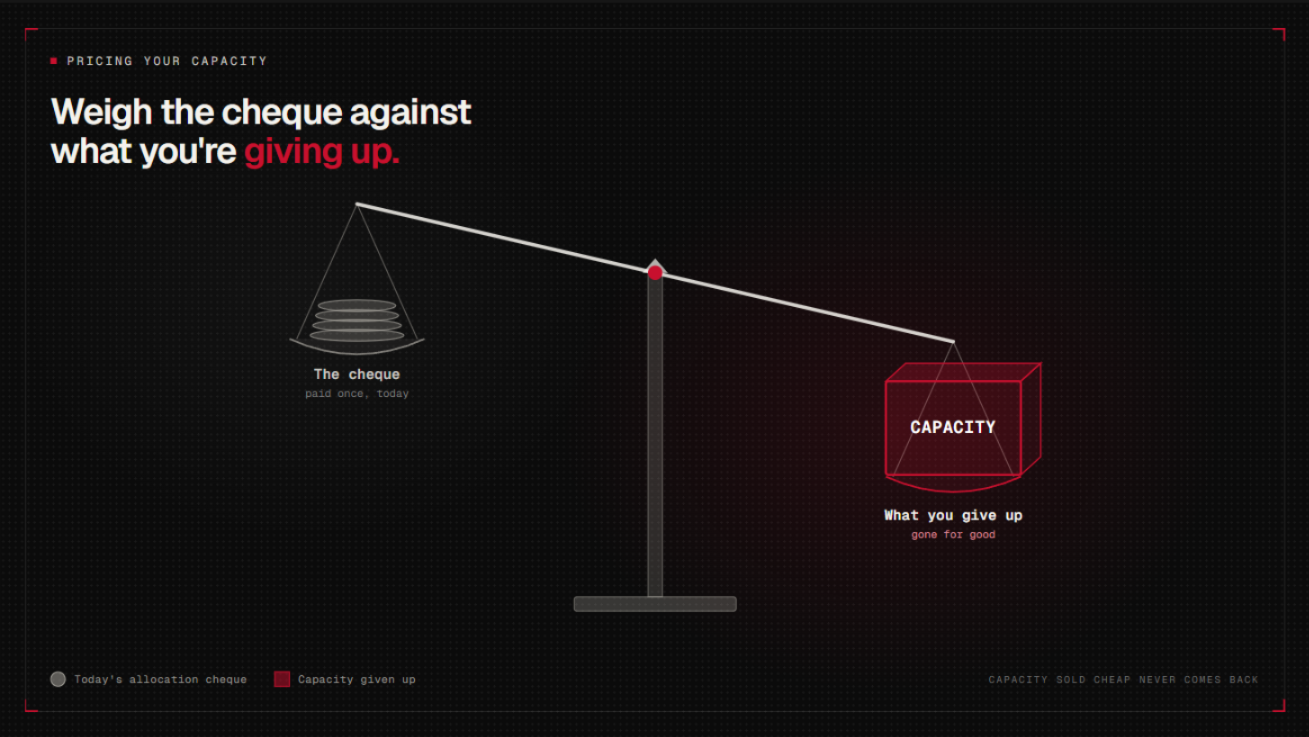
Don't sell your capacity for less than it's actually worth. A systematic book has a ceiling on the capital it can run before performance degrades. Capacity is the scarce asset in the whole negotiation. Hand a cornerstone investor half of it at a discount and you've sold the one thing you can't make more of.
Deal quality beats deal size. Run the numbers on what the capital actually costs you, and walk when they don't work. Walking away is itself a credibility signal.
What kills a raise?
Overclaiming, mostly.
The fastest ways to end an allocator conversation: performance that can't be verified live; a "diversified" book whose strategies all express the same trade once attribution is run (the "we don't have correlated bets" claim rarely survives a sharp LP); simulated results presented alongside live ones without a bright line between them; and a manager who posts more than he trades. Track record first, content second. An audience is merely a distribution channel.
One name worth your time here: Claudia Quintela. If you're serious about raising, she's who to learn this from at the source. Claudia spent 25 years inside the machine, State Street, UBS and Morgan Stanley, before setting up Vibe Advisors, her own placement boutique that finds backers for emerging managers by raising institutional capital.
She writes a Substack, The Emerging Manager, on exactly this: investor psychology, what allocators actually want, and what to watch for when you're early and small. I've sat with her in person a couple of times and had the whole picture reframed in an afternoon, and I've taken enormous value from our conversations. I've pulled together just shy of $4m in AUM as an emerging manager. Claudia works at a different altitude entirely, the raises she runs go into the tens and hundreds of millions.
Subscribe to The Emerging Manager and get this from someone who has done it at scale. We've also recorded an episode with her for Darwinex Zero's Fly on the Fund Wall podcast, out in the next month or two.
Common questions
Do I need to set up a fund or company before finding investors?
For most individual traders the sensible sequence is to use an existing regulated structure first (allocation programmes, managed-account platforms, signal-provider agreements) and only consider a fund wrapper when the economics justify the legal and compliance cost. The structure question is downstream of the record question. On this, however, always make sure that the structure you're operating through is dealing with regulators in the correct manner.
How much of my own money should be in the strategy?
Enough that a bad month hurts you too. Allocators read skin in the game as the cheapest honesty signal available, and its absence can be a red flag to someone willing to put up size.
How long a track record do I need before anyone allocates?
Twelve months of live, third-party-verified performance is the practical floor. The trade sample matters as much as the calendar: an allocator wants evidence across regimes, and a thin year proves less than a dense one.
Should I take money from friends and family?
Treat it as the highest-cost capital you will ever manage. If you take it, document it like an institutional deal: written terms, clear risk disclosure, a reporting cadence, and an exit mechanism agreed upfront. Personally, I will never manage friends & family capital. Just out of preference. For me, work & personal life are completely separate.
The unglamorous truth
The answer to "how do I find investors for my trading strategy" is a sequence. Build a verified live record. Protect it for at least a year. Let programmes and platforms compound it. Grow the network while it matures, and hold the line on deal quality when the offers finally arrive. Slow, boring, and it works. The traders I've watched raise successfully all ran some version of that sequence. The shortcuts I've watched people take all ended in the same place: no capital, or capital they came to regret.
Personal commentary, not advice. Capital at risk.
Disclosure. I work for Darwinex (FCA-regulated). This is my personal commentary, not advice. Capital at risk. I am an employee of Darwinex; content touching Darwinex products may represent a conflict of interest, disclosed per MAR Article 20.
XAQP figures are point-in-time as of July 2026 and will change.
Get the next letter in your inbox.
Please consider subscribing to receive more episodes of The Letter.
Subscribe now