Fixed Risk Isn't Fixed
Why your fixed risk-per-trade takes a different bet every week, and what to do about it.
- A fixed risk-per-trade ignores volatility regimes: the same 1% of equity on a 50-pip stop is a completely different bet in a calm month versus a volatile one.
- Scale position size to realised volatility so the risk stays constant in vol-adjusted terms. When the instrument gets jumpy, the position comes down.
- Per-trade vol-scaling is the first layer. A portfolio risk overlay on top catches correlated positions stacking into a single large bet.
Pick a number. One percent per trade, two percent, whatever a course once told you was sensible. A lot of systematic traders set a risk-per-trade early, wire it into every strategy, and never look at it again. That single fixed number can and will shape your returns more than half the parameters you obsess over optimising.
What does a fixed risk-per-trade actually do when the market changes?
A constant fraction feels safe because it sounds disciplined. Risk the same slice every time, no emotion, no overreach. The problem is that the market underneath that number does not hold still. Volatility doubles and halves across regimes, and a risk setting that ignores volatility can be taking a different bet every week whilst your risk percentage is telling you it is taking the same one.
A risk setting that ignores volatility can be taking a different bet every week whilst your risk percentage is telling you it is taking the same one.
Work it through.
Suppose your strategy always uses a fixed 50-pip stop and risks 1% of equity. In a calm month, that stop may sit three times the average daily range. In a volatile month, it's only a fraction of the daily range. You're still risking 1% of equity on paper, but you're taking a very different bet relative to how the market is moving.
So what is the alternative?
Scale the size to the volatility, so the risk stays constant in vol-adjusted terms rather than in percentage terms. The mechanic is simple: measure recent realised volatility on the instrument, usually something like average true range or a rolling standard deviation of returns, and size the position so that a one-unit adverse move costs you roughly the same fraction of the book regardless of regime. When the instrument gets jumpy, the position comes down. When it calms, the position can breathe.
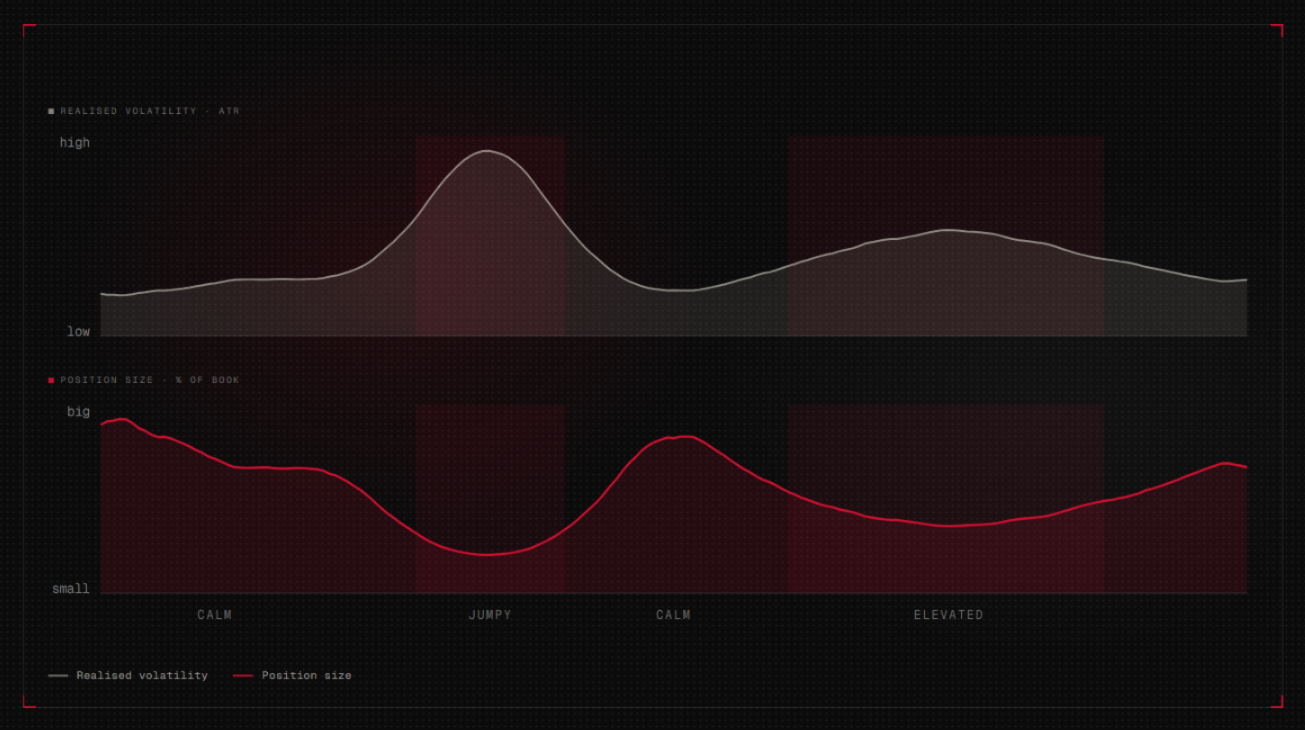
This is what people mean, or should mean, when they say dynamic risking: the difference between a book whose risk you actually control and a book whose risk the market sets for you while you watch a comforting constant on the dashboard.
Doesn't volatility targeting just move the problem around?
Fair challenge, and yes, it introduces its own decisions. How long a lookback for the volatility estimate. How fast you let the size adjust. Whether you cap how large a calm regime is allowed to make a position, because vol-targeting into a low-vol blow-off can load you up right before the regime breaks.
These are real questions and they need testing. But they are the right questions. A fixed fraction doesn't make them go away. It just answers all of them with ignore volatility entirely, which is the one answer you can be sure is wrong.
Where the second layer comes in
I run risk at two levels, and the per-trade sizing is only the first. Each sub-strategy is built to a tight maximum historical drawdown at its own level, and the portfolio carries its own risk overlay on top of the individual strategies.
That second layer matters because vol-scaling each strategy in isolation still lets correlated positions stack into a single large bet when several strategies size up in the same calm regime at once. You need both, because the failure modes live at different levels and a control at one level cannot see the other.
The thing to take away
Go and look at the risk-per-trade you set when you started, and ask whether it is a decision or a default. If it is a fixed cash or percent figure with a fixed stop distance, the amount you actually put at risk swings with the volatility regime, and you have no idea what that number is on any given day until the drawdown tells you.
The highest-leverage change most systematic books can make is in the risk layer.
Make it respond to the market instead of sitting frozen while the market moves around it. Same strategies, far more deliberate book.
Disclosure. Personal commentary, not financial advice. Capital at risk. I am an employee of Darwinex; content touching Darwinex products may represent a conflict of interest, disclosed per MAR Article 20.
XAQP figures are point-in-time as of June 2026 and will change.
Get the next letter in your inbox.
Please consider subscribing to receive more episodes of The Letter.
Subscribe now