Everyone Sees You Bleed
The psychology of public track records, systematic trading, and surviving drawdowns while everyone watches.
- A private track record can hide a bad month forever. A public one cannot, which is why a public one is worth anything.
- Running a system doesn't remove the pressure. It moves it. The discipline lives in the rules; the discomfort lives in me.
- The scrutiny is the product. Diamonds are only made when they don't shy away from the cutter.
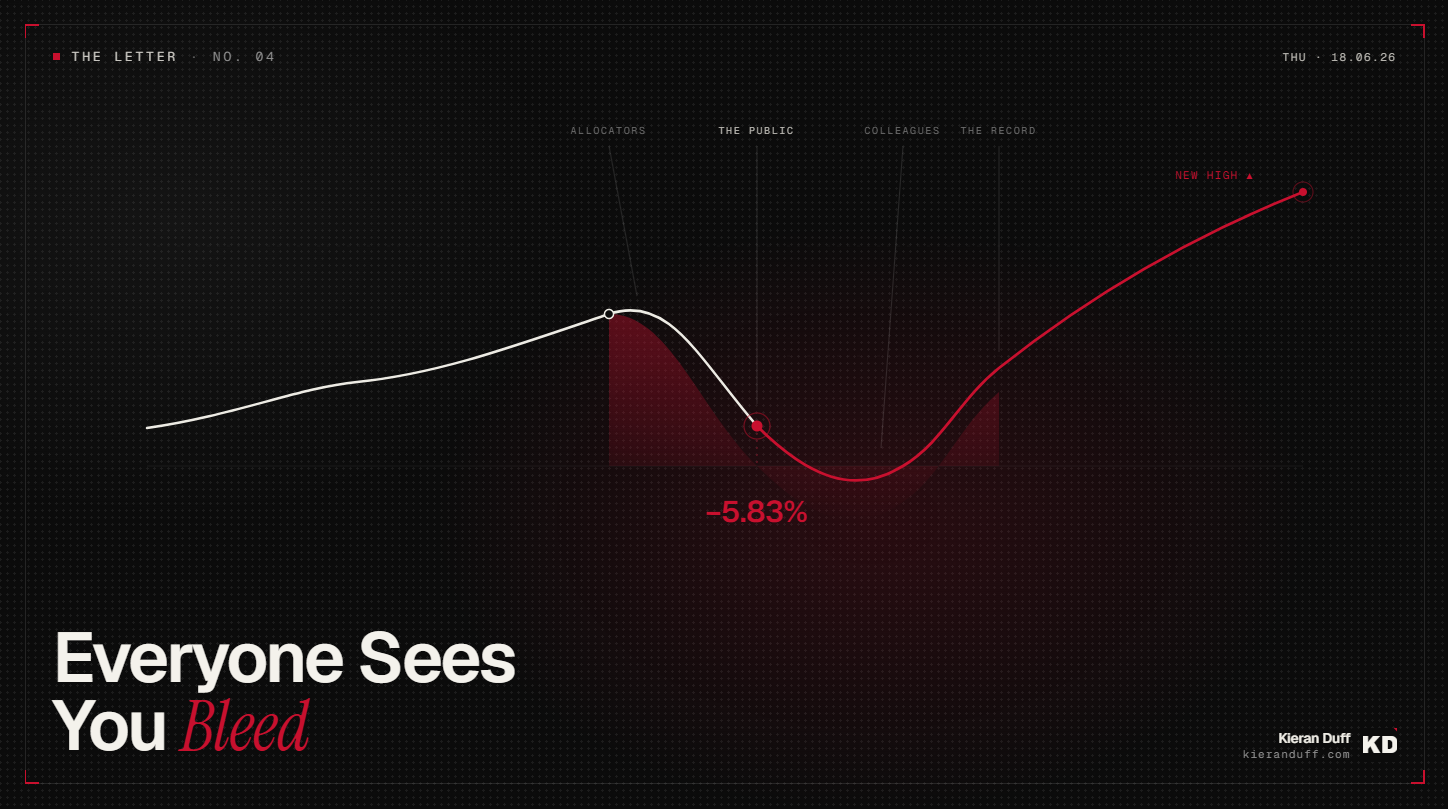
The pressure of building a public, verified trading track record at Darwinex is real. I know exactly why I let the scrutiny cut.
I run a systematic strategy on Darwinex, with real capital behind it and a track record sitting in public, meaning anyone can pull it apart. Every figure. Every drawdown. The months I am proud of and the ones I would rather not talk about. I also work at Darwinex. Internally, the team can see my record as easily as I can. Externally, clients have watched me build it in public through livestreams over the past year. There is nowhere to hide a bad week. That is a strange kind of pressure, and I have stopped pretending it isn't there.
Why does a public track record feel different from a private one?
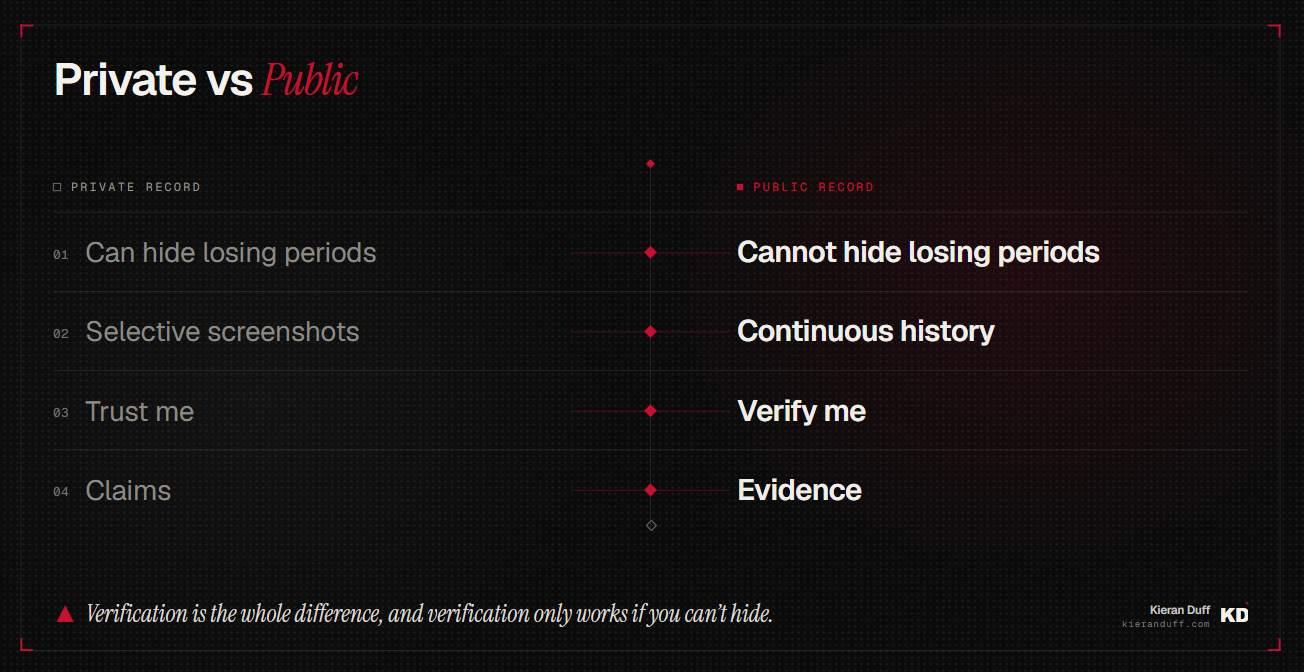
Because most trading records are invisible, and invisible records lie by omission.
You have seen the standardised risk warning every regulated CFD provider has to show. The FCA requires firms to show the percentage of retail client accounts that lose money, and those figures are usually ugly. Most people ignore that warning because they assume it applies to someone else. What it actually means is simple: many people who tell you they trade are inside that statistic, and you will never see their account stats proving otherwise. I view hundreds of track records each month as part of my role at Darwinex. I see this unfold in real time.
When I put my name and my numbers somewhere anyone could check them, I gave up the hiding place, because the curve updates whether the month was good or not. The drawdowns are in there next to the recoveries, auditable, with nowhere to file the embarrassing ones.
That is the trade I made. I lost the comfort of a record only I could see. In return I got one that means something, because it has been sitting out in the open being tested the whole time.
Doesn't the system carry the weight for you?
This is the assumption I get most, and it is almost exactly backwards.
People hear systematic and picture a machine doing the worrying so I don't have to. The algo carries the load, the thinking is done, I sit back and watch the money arrive. The reality is that the system executes precisely the same in a drawdown as it does on a record day. It feels nothing. It second-guesses nothing. It does not refresh the equity curve at eleven at night to see how bad the damage looks.
All of the discipline lives in the rules. All of the discomfort lives in me. I built it that way deliberately, so the worst version of me never gets to touch a position. I have written before about the cost of discretion. This is the live version of that cost. The calm of the strategy is bought with my own lack of it. The system is steady precisely because I am the part that isn't, and I have quarantined that part where it can't do any harm.
So the weight doesn't disappear when you systematise. It stops landing on your decisions and starts landing on your nerves.
What does a drawdown feel like when people are watching?
It feels like sitting still while something uncomfortable happens to you in a room full of people.
The audience is not some faceless crowd on the internet. It is colleagues. Allocators. Investors. Traders I have spoken to on livestreams. People who know exactly what a drawdown feels like because they have lived through their own. That almost makes it worse, because they understand what they are looking at.
Drawdowns come. They always come; a strategy that never drew down would be a strategy I would not trust, because it would mean I had curve-fit it to a past that won't repeat. When one arrives, there is nothing for me to do. I cannot trade my way out to make the chart look better, because the entire value of the thing is that I do not interfere with it. I can't tighten a stop to soothe my own anxiety, or skip a trade because the timing feels wrong this once. The moment I start overriding the system to manage how the curve looks to an audience, I have stopped running a system and started running my feelings, in public, with money attached.
So the only job left during a drawdown is the hardest one. Hold my nerve. Let the process do what the data said it would, while it is uncomfortable to watch and while people are watching me watch it.
XAQP runs across FX, indices and metals, and on any given week some part of that book is having a bad time. That is normal. The discipline is in not treating normal as an emergency just because it is visible.
So why keep it public at all?
Because the scrutiny I can't escape is the same scrutiny that makes the good numbers believable. This is where the line I keep coming back to earns its place.
Diamonds are only made when they don't shy away from the cutter.
A diamond becomes a diamond by being held against the wheel and cut, hard, in exactly the places that look most like damage. Pull it away to keep it safe and you are left with a lump of carbon that could have been something. The cut is the stone.
A track record works the same way. The drawdown I have to sit through with an audience is the same drawdown that proves the strategy survives them. If I had kept everything private, comfortable, uncut, the good months would be worth nothing to the people whose money I am asking to manage, because they would have only my word for it, and my word is the cheapest thing I own.
Does the pressure actually make you a better trader?
No, and I am not going to pretend otherwise.
Pressure makes most traders worse. Fear and ego override the plan at exactly the moment the plan matters most. That is not a character flaw to be willed away; it is how people are built under stress, and it is the single biggest reason discretionary traders blow up. The entire point of running a system is to take those decisions away from the version of me that is feeling the pressure.
The scrutiny does not improve the trading. The rules protect the trading; the scrutiny tests whether I can keep my hands off the wheel while the rules do their work. That is the one thing no backtest can ever measure. A backtest can tell me how the strategy behaved in 2019. It cannot tell me whether I will sit on my hands through a live drawdown with my colleagues, my allocators and a public curve all watching at once. Only doing it tells me that, and the only way to find out is to be exposed while it happens.
Common questions
Is trading in public just a marketing exercise?
It can be, and a lot of it is. The thing that separates a verified track record from a livestream or screenshots is that you can't choose which months to show. Every figure is auditable, the losing ones included, which is the opposite of a curated feed.
Does a systematic strategy remove the emotional pressure of trading?
No. It relocates it. The system removes emotion from the decisions by putting them in rules, but the discomfort of watching a drawdown play out doesn't go anywhere. If anything it concentrates, because you have deliberately denied yourself the option of intervening to feel better.
Why not just trade privately until the record is strong, then go public?
Because a record built in private was never tested by the one pressure that matters: the temptation to interfere when people are watching and the curve is red. A clean private record proves the strategy worked in private conditions. It leaves the public-pressure question unanswered.
The cut is the point
The uncomfortable version of this is the only honest one. A track record protected from scrutiny is a lump of carbon dressed up as a diamond, and anyone serious can tell the difference. The reason I leave the bad months in, the reason I let people I work with read my curve, the reason I don't touch the system when sitting still is the hardest thing in the world, is that the cut is what makes the thing worth holding.
Diamonds don't shy away from the cutter. Neither do I. The cut is unpleasant. I already know what is on the other side.
Disclosure. Personal commentary, not financial advice. Capital at risk. I am an employee of Darwinex; content touching Darwinex products may represent a conflict of interest, disclosed per MAR Article 20.
XAQP figures are point-in-time as of May 2026 and will change.
Get the next letter in your inbox.
Please consider subscribing to receive more episodes of The Letter.
Subscribe now