How To Get Started With Systematic Trading
A Complete A-to-Z Guide Covering Strategy Design, Backtesting, Risk Management and Automation.
- Systematic trading starts by turning a market idea into exact rules a computer can test and execute.
- No-code tools are enough for a first complete build; code and AI become useful once you hit their limits.
- The real filter is validation: out-of-sample testing, parameter stability, Monte Carlo, and risk controls before live capital.
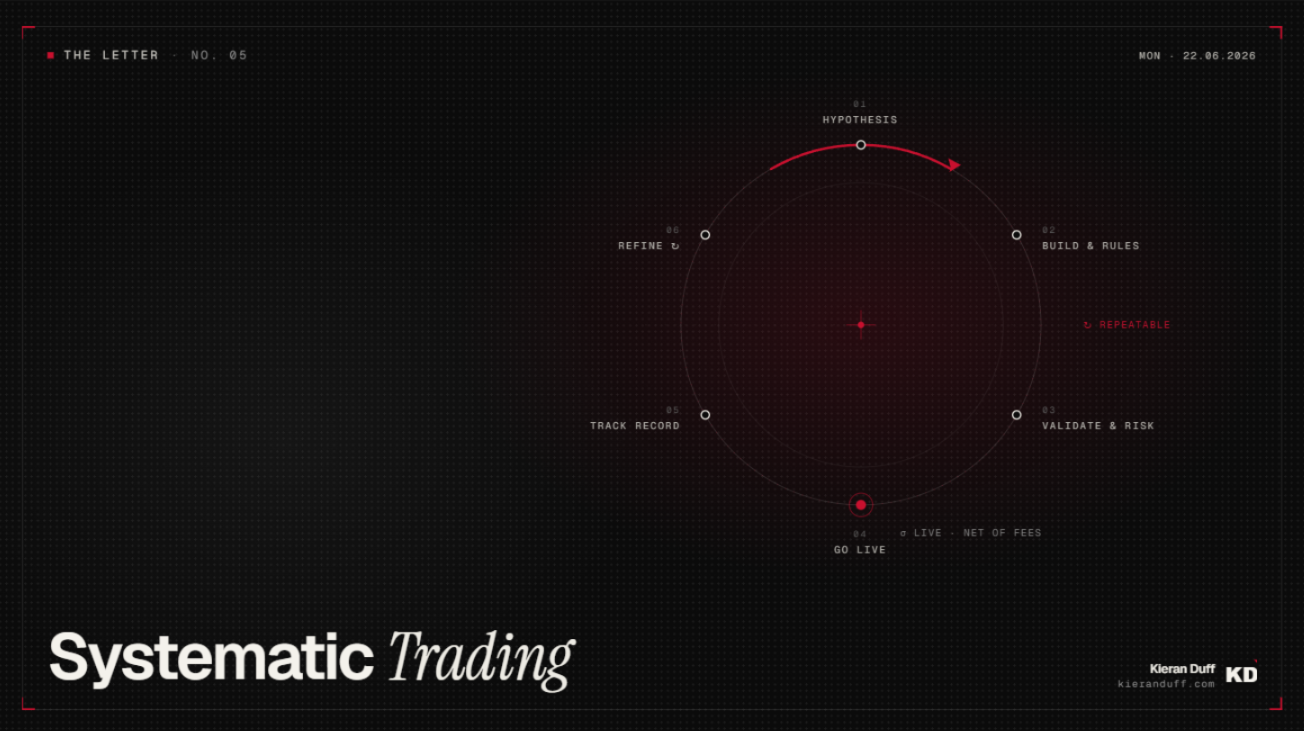
If you're looking to enter the world of systematic trading, I highly recommend that you read the full handbook I released for free on my website.
The Handbook
Systematic trading is the path I took after years of trading by hand, and getting started is more achievable than most think. This is the complete A-to-Z: what systematic trading actually is, the platforms to build on whether or not you can code, how to test a strategy so it survives live, how to manage risk, and how to build a track record that means something. The major difference here is simple: I'm talking from experience. For those who don't know me, I am the manager behind XAQP, a systematic portfolio with almost $4M of investor capital.
XAQP
XAQP is my own systematic portfolio, live since April 2025. I reference it in this guide because it is the thing that forced the lessons below out of theory and into real process.
A fair warning before we start. This is a long one, because doing it properly is the whole point. Bookmark it, work through it in stages, come back to it. By the end you will have a clear map of what to actually do, without leaving with more questions than you arrived with.
The journey at a glance
- Understand what systematic trading is and why it suits traders that discretionary has not worked for.
- Generate strategy ideas and turn them into testable rules.
- Build your first strategy without writing a line of code.
- Level up to the code path when you are ready.
- Backtest, then validate properly so you are not fooling yourself.
- Manage risk at the strategy and portfolio level.
- Automate execution and go live carefully.
- Build a verifiable track record.
What is systematic trading?
Systematic trading means a defined set of rules makes your decisions. Your judgement in the moment is removed from execution. A strategy is a set of conditions: when this happens, do that, size it this way, exit under these circumstances. Once the rules are written, a computer can test them across years of history and eventually execute them for you without you sitting at the screen, although it's likely you'll end up spending just as much time at the screens.
Discretionary trading puts you in the loop on every decision. That is a valid craft. Plenty of brilliant traders are discretionary. The issue, and the reason I switched, is that human judgement is inconsistent. You make a clean decision on Tuesday and a tired, emotional one on Friday, and the variance in your own state ends up larger than the edge you are trying to trade. If you have been trading discretionary and have not turned the corner to consistent profitability, this inconsistency is very often the reason.
Systematic trading takes your judgement out of execution and replaces it with rules that behave the same way every single time. The work moves from making decisions to designing and testing the rules that make the decisions for you. For a lot of people, me included, that is the unlock.
The work moves from making decisions to designing the rules that make the decisions for you.
Step 1: Get your foundations right before you build anything
Before you touch a platform, you need a few concepts solid in your head. Skip this and you will build something confidently broken.
Edge. An edge is a reason your strategy makes money that is more than chance. It might be that markets trend, that they mean-revert after a stretch, or that volatility clusters. Your strategy has to express a real edge, otherwise you are automating randomness with extra steps.
Expectancy. This is the average outcome of your strategy per trade, accounting for win rate and the size of wins versus losses. A strategy that wins 40% of the time can be very profitable if the winners are large enough. A strategy that wins 70% of the time can lose money if the losers are big. Win rate on its own tells you almost nothing.
The difference between a rule and a feeling. The hardest part of going systematic, especially coming from discretionary, is being forced to write down exactly what you do. "I buy when it looks strong" is a feeling. "I buy when price closes above the 20-day high and the 50-day average is rising" is a rule. The act of converting your instincts into precise, testable conditions will immediately show you whether your edge is real or whether it has been living vaguely in your head.
Get these three straight and everything gets easier.
Step 2: Where do strategy ideas come from?
A blank screen and "build a strategy" is paralysing. Ideas come from a few reliable places.
The first is your own discretionary experience. If you have traded by hand, you already have patterns you believe in. Your job is to articulate them as rules. This is the richest source for most people coming across from discretionary, and it is where I would start.
The second is market behaviour you can observe and reason about. Trends, breakouts, reversals after extremes, the way certain instruments behave around specific sessions. You form a hypothesis, then you test whether it holds.
The third is systematic idea-generation and data-mining tools, which use algorithms to search huge numbers of rule combinations and surface ones that performed well historically. These are powerful. They are also the easiest way to fool yourself, because a tool that tries millions of combinations will always find something that looks brilliant on past data by pure luck. Used well, with the validation discipline in Step 5, these tools accelerate the search. Used carelessly, they manufacture overfit junk at scale.
Whatever the source, the output of this step is the same: a clear, written hypothesis you can build and test.
Step 3: How do you build your first strategy without code?
Here is the good news: you do not need to learn to code to start. No-code build platforms are genuinely capable, and they are where I would point anyone getting started.
fxDreema is a visual, block-based builder for MetaTrader 4 and 5. You connect logical blocks together to define your entries, exits and sizing, and it produces a working expert advisor (an automated strategy) you can run on MetaTrader without writing code. It is a brilliant place to turn your first hypothesis into something real.
StrategyQuant X goes a step further. It is a no-code platform that can generate, test and refine strategies at scale, using its own fast backtesting engine to evaluate enormous numbers of candidate strategies. This is also where the data mining from Step 2 actually happens: you set your parameters, then let it run heavy processing to mine and rank thousands of candidate systems. It forces you to think in components, signal, entry, exit and sizing separately, which is exactly the right mental model. Its recent versions also let you describe a strategy in plain English and have it built for you. This is the workhorse for a lot of serious retail traders.
Start with one of these, take a single hypothesis from Step 2, and build it. Do not aim for perfection. Aim to get one complete, rule-based strategy built and ready to test. The first one you build is a learning exercise. The skill you develop building it is the actual prize.
Step 4: When should you move to code?
The no-code platforms will carry you a long way. At some point, if you get serious, code gives you more control, more flexibility, and access to things the block builders cannot easily do.
QuantConnect is a strong cloud-based path for coded strategies. It supports Python and C#, gives you a large historical data library, a free backtesting environment, and a path all the way through to live deployment. It is a step up in difficulty, and it is worth it when you reach the ceiling of what no-code can do for you.
Here is where it gets interesting in 2026, and where I spend a lot of my own energy. You no longer have to be a strong programmer to write code, because AI build tools have changed the game. I use AI assistants like Claude and Codex aggressively to write strategy code, build the tooling and workflows around my strategies, debug, and automate the boring parts of running a systematic book. You can describe what you want in plain English and have working code produced, then learn from it as you go. I build systems and workflows that let my strategies thrive, and AI is doing a large share of that heavy lifting.
The part that compounds is what you keep. Every time I build a piece of code that works, and works well, I save it. Do that for long enough and you end up with your own encyclopaedia of code: a library of proven blocks you have already run on your own strategies. The value comes later. Point an AI agent at that library and it stops starting from a blank page. It reuses the risk module you already trust, and the execution wrapper you spent a week getting right. Anything new, it writes in your existing patterns. The work you did once keeps paying you back. Mine grows every week, and Claude/Codex leans on it constantly, so every new build starts further down the road than the last.
My honest advice: start no-code, get a strategy working and tested end to end, and let the curiosity pull you toward code when you hit the limits. Do not start by trying to learn Python. Start by building something that works, then expand your tools.
Start by building something that works, then expand your tools.
Step 5: How do you backtest and validate properly?
This is the step that separates people who make money from people who blow up, so read it twice.
A backtest runs your strategy over historical data to see how it would have performed. Every platform above does this. The trap is that a good-looking backtest means almost nothing on its own, because it is trivially easy to build a strategy that fits the past perfectly and fails completely in live trading. This is called overfitting, and it is the single most common way new systematic traders destroy themselves.
Here is the validation process I actually use, and it is non-negotiable.
Optimise on a small in-sample period. Use a limited slice of history to develop and tune the strategy. Do not optimise across all your data, because you need clean data left over to test on.
Run walk-forward out-of-sample testing. Test the strategy on data it has never seen, in a way that simulates moving forward through time. If it holds up on data it was not tuned on, that is a real signal. If it falls apart, your in-sample result was a mirage.
Test on old out-of-sample data too. I also run the strategy on data from before my in-sample period, earlier history that was not used for optimisation. A strategy that works on both the future and the past it never saw is far more trustworthy.
Never optimise too heavily. The more knobs you turn to make the backtest pretty, the more you are fitting noise. Restraint here is a key discipline.
Check parameter stability. Nudge your parameters slightly. If shifting a setting by a small amount collapses the strategy, you have found a fragile curve-fit. A real edge is stable across a range of nearby settings.
Run Monte Carlo on the trade sequence. This reshuffles and stresses the order of your trades to show you the range of outcomes you could realistically have had. It tells you whether your equity curve was durable or whether you got lucky with the ordering.
If a strategy survives all of that, you might have something. If it does not, kill it without sentiment. I have killed far more strategies than I have kept.
Step 6: How should you manage risk?
Risk management is not a step you do at the end.
Start with position sizing: how much you risk per trade as a fraction of your capital. Keep it small. The goal early on is survival, then growth.
Then think in two layers, which is how I run my own book. The first layer is risk control at the level of each individual strategy, so no single strategy can do serious damage on its own. The second layer sits on top of the whole portfolio, capping what everything can lose together when markets get correlated and your strategies all move the same way at once. A lot of people only manage the first layer, and the second is the one that saves you in a crisis. I have written about this dual-layer approach in detail separately, and it is worth understanding properly before you scale.
Finally, make your risk responsive to conditions. A flat risk percentage is too much in violent markets and too little in calm ones. Sizing that adapts to volatility keeps your actual risk closer to constant as the market changes character.
Get risk right and a mediocre edge can still build wealth slowly. Get it wrong and the best edge in the world will not save you.
Step 7: How do you automate execution and go live carefully?
Once a strategy has survived validation, you move toward live execution. MetaTrader 5 is the execution platform I use, and the no-code builders above produce strategies that run on it directly. QuantConnect has its own path to live deployment.
Before you risk a penny of real money, do this in order.
Run it on demo or paper first. Backtest is theatre. Live is real. Run the strategy forward on a demo account, or a small live account if you can. I use Darwinex Zero for testing, as it is live conditions and live servers with virtual capital, meaning you test with enough margin and no capital risk. Of course, as always: I am an employee of Darwinex, so please take this as a biased recommendation. It is still part of my trader stack and I will always be honest about where I see value. Do this for a meaningful period and confirm its live behaviour matches what you tested. The gap between the two is the gap you most need to understand.
Go live with small size. When you do commit real capital, start small enough that the inevitable surprises are survivable. You are buying information about how the strategy behaves with real fills, real costs, and real slippage.
Scale once it earns it. Add size as the live results confirm the strategy is doing what it was built to do.
You do not want to be finding out that you've left vulnerabilities within your code whilst running it on a live book. Believe me, I've been there a few times.
Step 8: Why does a verified track record matter?
This is the part that turns a hobby into something more, and it is where the real opportunity sits.
A verifiable track record is the single most valuable asset a systematic trader can own. Screenshots of profit are cheap. Stories are cheaper. An independently recorded, auditable history of real performance is the thing that separates results from claims, and in this industry the difference is everything.
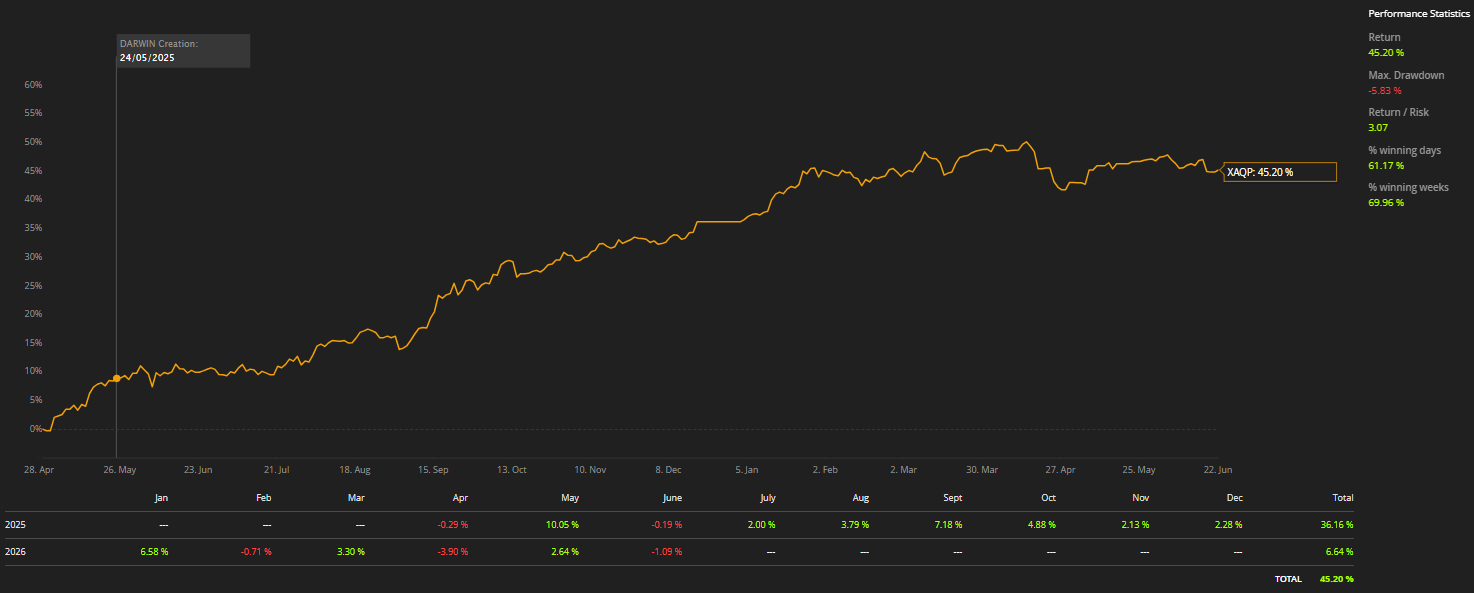
Platforms like Darwinex let you trade your strategy and build a public, verified track record, and can open the door to managing external capital if your performance is strong enough over time. That is the path I have taken with my own strategy, XAQP, which as of 22 June 2026 had produced a live return of +45.27% since inception in April 2025, a Sharpe of 3.72, and a maximum drawdown of -5.83%, with assets of around $3.7M. I am telling you because none of it would mean anything without the verified record behind it. The numbers are only worth something because they are real and independently tracked.
Start building your record as early as you sensibly can. A year of verified, real performance is worth more than any amount of talk, and the best time to start the clock is the moment you have a strategy worth tracking.
A year of verified, real performance is worth more than any amount of talk.
The honest part: how long does this take?
I will not insult you with a timeline that sells a dream. If you are coming from discretionary with a real feel for markets, you can have a tested strategy built in a few months of focused work. Building genuine, consistent profitability and a track record worth showing is a longer game, measured in years.
The seven years I spent trading discretionary were not wasted when I went systematic. Every one of them sharpened my read of markets, and all of it fed into the strategies I now build. You cannot skip the learning. What you can do is point it in a direction that compounds, which is exactly what going systematic did for me.
Start now, start small, build one strategy properly, and let it teach you the next one.
Common questions
Do I need to know how to code to trade systematically?
No. No-code platforms like fxDreema and StrategyQuant X let you build and test real strategies without writing a line. Code becomes useful later when you want more control, and AI tools now make writing it far more accessible than it used to be.
How much money do I need to start?
You can build and test for free or close to it, and demo trading costs nothing. When you go live, start with an amount small enough that the learning is affordable. The early goal is information and survival.
Is systematic trading better than discretionary?
Neither is inherently better. They suit different people. Systematic suited me because it fits my life and removes the inconsistency that held my discretionary trading back. If you have struggled to stay consistent by hand, systematic is worth a serious look.
How do I avoid overfitting?
Validate properly: optimise on a small in-sample period, test out-of-sample with walk-forward, test on older unseen data, check that nudging parameters does not break the strategy, and run Monte Carlo on the trade sequence. If it only looks good on the data you built it on, it is overfit.
What's the first thing I should do today?
Take one trading idea you genuinely believe in, write it down as precise rules, and build it in a no-code platform. Getting one complete strategy built and tested end to end will teach you more than months of reading.
Where to go from here
That is the full map, from your first concept through to a verified track record. If you want the deeper versions of each step, the strategy building, the validation discipline, the risk architecture, I write about all of it every week in The Letter. Subscribe and follow along, because this guide is the overview and the real detail lives in the weekly pieces.
I also released a free 24-chapter handbook on my website recently, going into the semantics of everything systematic. I would highly recommend reading that front to back, perhaps a few times, and testing as you go.
Start with one idea. Turn it into rules. Test it properly. Then let the work compound.
Disclosure. Personal commentary, not financial advice. Capital at risk. I am an employee of Darwinex; content touching Darwinex products may represent a conflict of interest, disclosed per MAR Article 20.
Past performance. Past performance is not indicative of future results. XAQP figures are point-in-time as of 22 June 2026 and will change. Figures are before fees (gross), denominated in USD, and actual investor returns will be lower after fees.
Nothing in this letter constitutes investment advice, a solicitation, or an offer to buy or sell any financial instrument.
Get the next letter in your inbox.
Please consider subscribing to receive more episodes of The Letter.
Subscribe now