How Much Capital Do You Actually Need?
Nobody can hand you one number for how much capital you need to trade systematically. Four things set it, and here is how to work out your own floor.
- Below a certain account size your broker’s minimum position size picks your risk for you, and it picks badly. Work backwards from minimum lot size and the per-trade risk you actually want.
- Fixed costs are a percentage drag that shrinks as capital grows.
- Real diversification costs capital, because every strategy needs room to take a sensible position. A multi-strategy book has a higher floor than a single system.
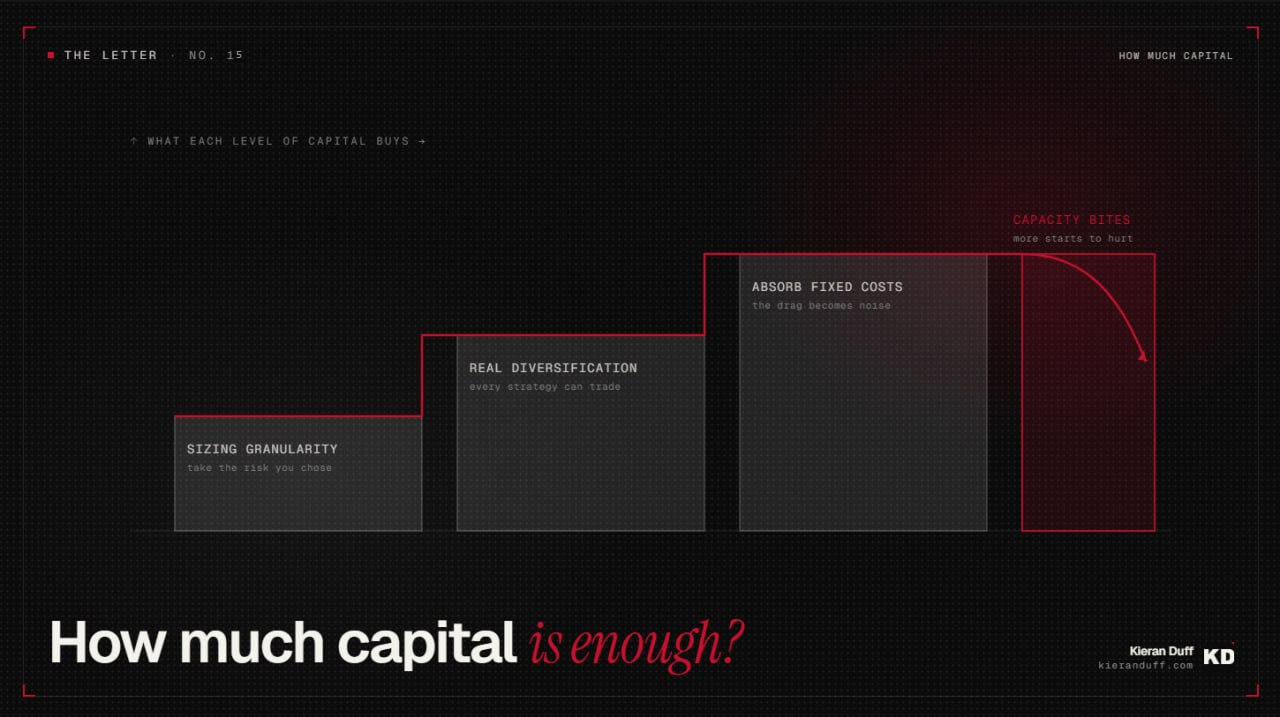
The arithmetic nobody wants to give you. Nobody can hand you a number, and anyone who does is guessing based on their own experience. Four things set it: your broker’s minimum position size, your fixed costs, how many strategies you run, and what the account is actually for.
Here is the arithmetic. Four things decide it, and I’ll show you how to work out your own.
Why is there no single number?
Because the question is really four questions.
How small a position can you take, given your broker’s contract sizes and your instruments. How much you’re paying in fixed costs before you make a penny. How many strategies you want running at once, and how much room each one needs. And what you’re actually trying to do with the account: learn, build a record, or earn a living.
Change any of those and the answer moves by an order of magnitude. Someone trading a single system on one FX major with a broker offering micro lots is in completely different arithmetic from someone running twenty strategies across indices and metals.
What does per-trade risk actually do to a small account?
This is the constraint that catches almost everyone, and it comes down to granularity: the smallest position you’re allowed to take. This happened to me late 2025, early 2026 with Gold (XAU) forcing minimum lot sizes of 0.01.
You decide, sensibly, to risk a small fraction of the account per trade. Then you go to place the position, and the smallest size your broker will accept, on that instrument, at your stop distance, risks considerably more than that. The minimum lot size has become the binding constraint, and now you’ve got a choice: trade a risk you didn’t choose, widen the stop until the maths fits and change the strategy in the process, or skip the trade.
All three are bad. The first is the most common and the most damaging, because it moves you into a per-trade risk your drawdown maths never assumed. Do that across a handful of strategies and your real risk of ruin looks nothing like the one you modelled.
So run the calculation before you fund anything. Take the per-trade risk you intend, as a percentage. Take the smallest position your broker allows on your instruments. Take your typical stop distance. The account size where those three reconcile is your genuine floor, and it’s specific to you.
Below that floor, the broker’s minimum sets your risk, whatever you intended.
How do costs scale against account size?
Two kinds of cost, and they behave very differently.
Variable costs, spread and slippage and swap, scale with your trading. They hurt proportionally and they hurt everyone, and they’re the reason a high-turnover edge that looks brilliant on gross returns can land near zero once you charge it realistically.
Fixed costs are the ones that get forgotten. Your VPS, your data, your platform licence, anything you pay for whether you trade or not. These are a percentage drag on returns, and that percentage is entirely a function of the denominator. A few hundred pounds a year of infrastructure is a rounding error on a large account and a meaningful hurdle on a small one, where it can demand a return of several per cent before you’ve made anything at all.
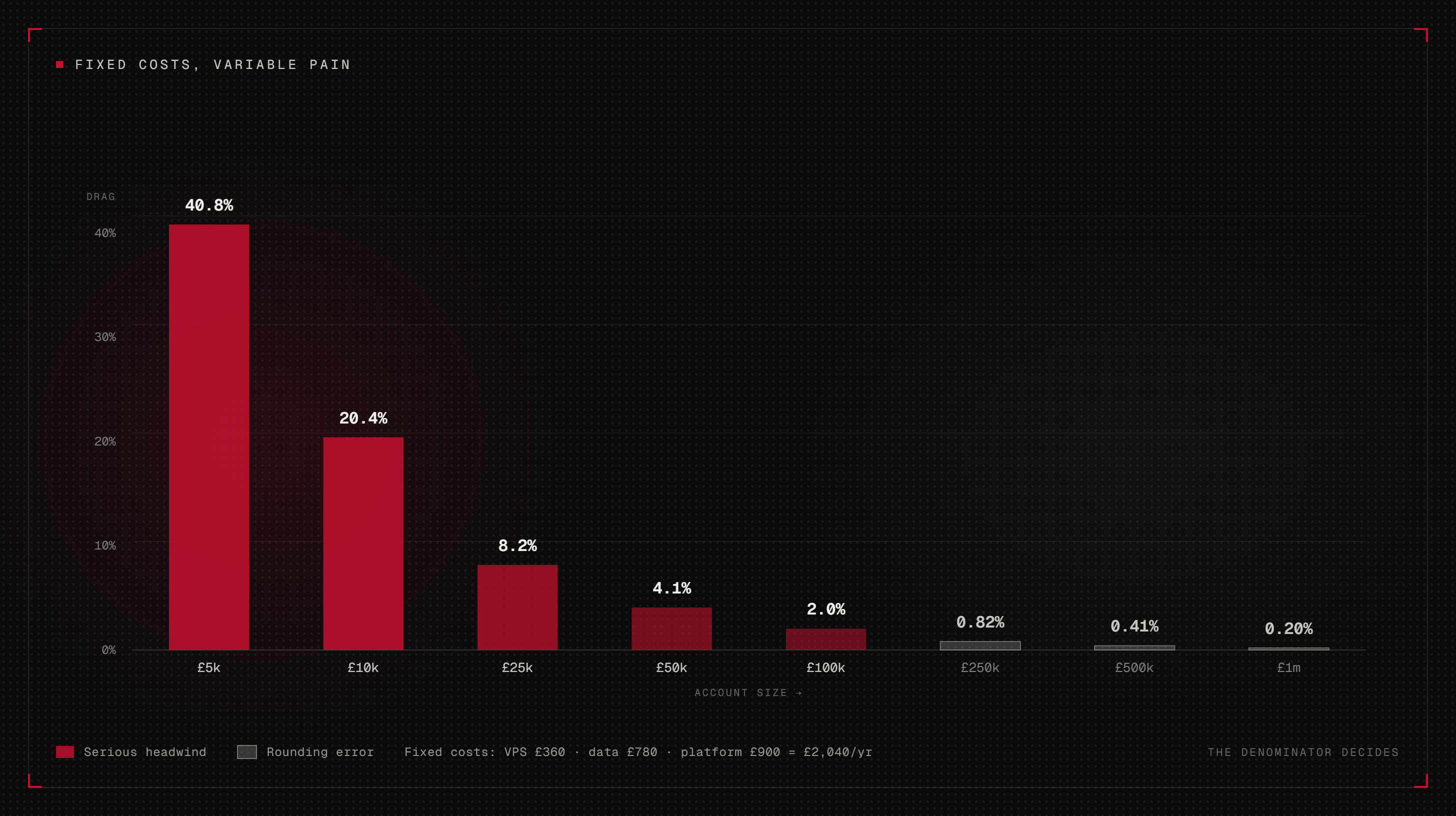
That doesn’t mean you skimp on infrastructure when the account is small. It means you should know the hurdle you’ve just set yourself, and be honest that a slice of your edge is now going on keeping the lights on.
Why does a multi-strategy book need more capital than one strategy?
Because diversification isn’t free, and this is the part that surprises people who’ve read all the right things about correlation.
The whole argument for running many strategies is that their bad days don’t line up, so the portfolio’s drawdowns are shallower than any single component’s. It’s a genuinely powerful effect. But it only works if each strategy can actually take a position, at a size that’s meaningful relative to the book and sensible relative to its own risk.
I run a multi-strategy book, and this is the constraint I’d flag to anyone trying to build one on a small account. If you’ve got twenty strategies and not much capital, most of them can’t trade without breaching your per-trade risk, so in practice you run three of them and call it a portfolio. The diversification lives in the spreadsheet; the account never sees it.
So the floor for a multi-strategy book is higher than people expect. Work out the account size where every strategy you intend to run can take its smallest allowable position while still risking a sensible slice of the whole. That number is a good deal larger than one strategy’s floor, and it’s the real reason serious diversification is a capital-intensive activity.
What can you genuinely do with a small account?
Quite a lot, as long as you’re honest about what it’s for.
A small account is an excellent place to learn the workflow end to end: build, test, deploy, monitor, reconcile, retire. Every skill that matters transfers upward, and the mistakes are cheap. It’s also a legitimate place to build a real, verifiable track record, which is an asset with genuine value in this industry and one I’d say most people never bother to create.
Where it catches people out is income. A sensible return on a small base is a small number, and the temptation to fix that with leverage is exactly the trap that empties accounts. Leverage doesn’t manufacture edge. It scales outcomes in both directions and shortens the road to ruin.
I’ll be straight about this one, because I’ve lived the other side of it. I traded as my sole income for a stretch, and I won’t do it again. These days the trading sits alongside the rest of my life and doesn’t have to fund all of it, and that shift took the desperation out of the account. A small account is brilliant at what it’s brilliant at. Learn on it. Prove something on it. Don’t ask it to pay your mortgage, because that request is what turns a decent system into a blown one.
When does more capital start to hurt?
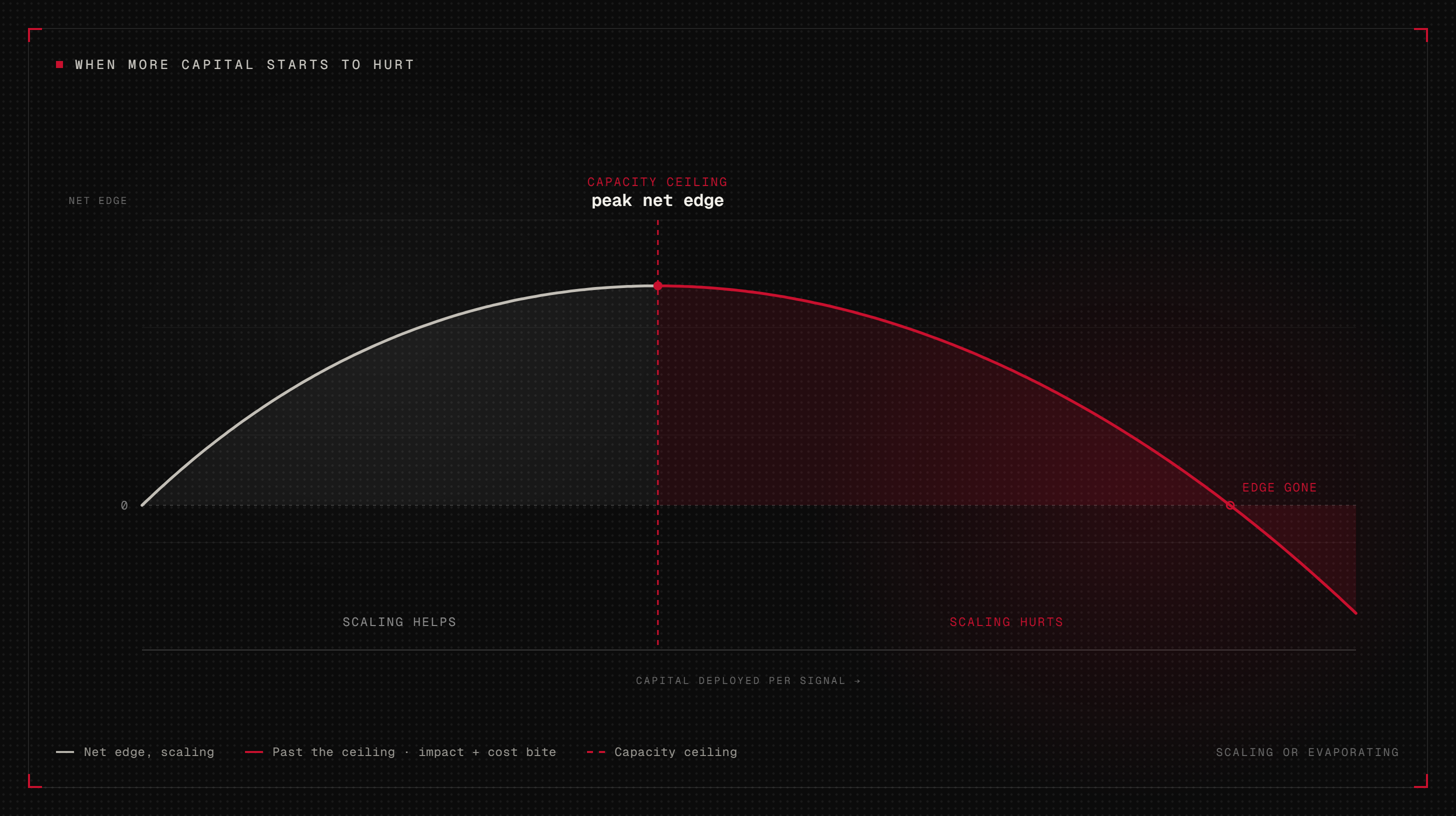
At capacity, and it arrives earlier than you’d expect.
Capacity is the point where your own size starts to work against you. At retail scale, capacity is a cost problem long before it’s a liquidity problem. Every extra unit of size pays the same spread per trade, so a high-turnover strategy hands over a fixed tax on every fill, and as size climbs, overnight financing compounds against anything you hold past the close. You’ll feel the cost drag long before you’re ever big enough to move a market.
So model your capacity ceiling as a cost curve against turnover and holding period. The liquidity number shows up much later, and it’s rarely the one that actually stops you.
This matters even at modest size, because it tells you which of your strategies can scale and which are small-account-only. Knowing that in advance beats finding out when you add capital and the returns mysteriously flatten.
Is trading other people’s capital the answer?
It’s an answer, and it changes the shape of the problem without removing it.
Running third-party capital lifts the constraint from money to credibility. You no longer need a large account. What you need is a real, verifiable edge, a record that survives scrutiny from someone who reviews these things professionally, and the operational discipline to run other people’s money without doing something stupid with it.
That’s a fair trade if your record is genuine, and a brick wall if it isn’t, because the scrutiny is exactly where a curated, screenshot-flavoured track record falls apart. Real capital, a real period, independently verifiable, bad months included.
If you’re seriously considering that route, the work is building the thing that would survive being looked at properly. That’s the same work you should be doing anyway, fundraising or not.
Common questions
Can you trade algorithmically with a small account?
You can run a system, learn the whole workflow and build a genuine track record, all of which have real value. What you usually can’t do is diversify properly or size sensibly, because minimum position sizes force your per-trade risk above where you’d choose it. Treat a small account as a place to train and to prove something, and don’t lean on it for income.
What is the minimum realistic account for a multi-strategy book?
Enough that each strategy can take its smallest allowable position while still risking a sensible fraction of the account. Work it backwards from your broker’s minimum lot size, your instruments and the per-trade risk you intend. The number comes out of the arithmetic, and no blog post can hand it to you.
Does a bigger account make trading easier?
Up to a point. More capital buys sizing granularity, real diversification and the room to absorb fixed costs. Past a point it introduces capacity problems, where your own size starts working against you.
Should I use higher leverage to compensate for a small account?
No. Leverage won’t create an edge that isn’t there. It magnifies whatever’s already happening, good and bad, and speeds up the path to ruin. If the arithmetic only works with aggressive leverage, the arithmetic doesn’t work.
Is third-party capital a shortcut?
It swaps a capital problem for a credibility problem. You still need a real edge and a record that survives being examined properly. Fair swap if the record is genuine, impossible one if it isn’t.
Size the ambition to the arithmetic
The reason this question gets answered so badly is that the answer is unglamorous. It depends on your broker’s contract sizes, your instruments, your stop distances, your fixed costs and how many strategies you actually intend to run. Do that arithmetic and the number stops being a mystery. It’s just maths, and it’s specific to you.
Starting small is fine. The damage comes from starting small and then behaving as though the account were large: leaning on leverage, skipping the diversification the maths demands, asking a modest base to produce an immodest income.
Start with the size you have. Size the ambition to the arithmetic, and build the thing that deserves more capital before you go looking for it.
Personal commentary, not advice. Capital at risk.
Disclosure. I work for Darwinex (FCA-regulated). This is my personal commentary, not advice. Capital at risk. I am an employee of Darwinex; content touching Darwinex products may represent a conflict of interest, disclosed per MAR Article 20.
XAQP figures are point-in-time as of July 2026 and will change.
Get the next letter in your inbox.
Please consider subscribing to receive more episodes of The Letter.
Subscribe now