Don't Trade For A Living
Why I stopped relying on trading to pay the bills and became a better trader because of it.
- Trading income is a probability distribution. Bills are a fixed monthly liability. Forcing the first to service the second degrades both your trading and your life.
- The maths of income-replacement trading demands either large capital or dangerous risk. Most aspiring full-time traders have neither, so they take the risk.
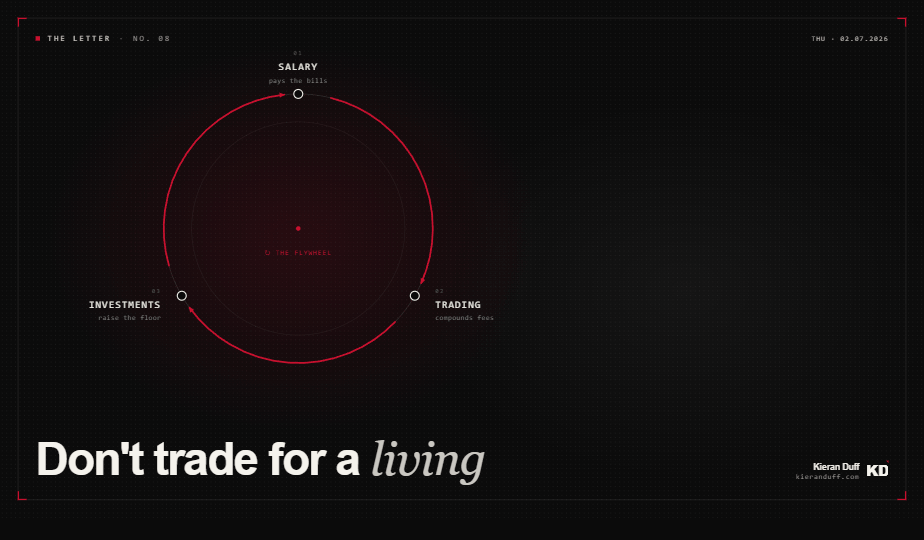
- The alternative is a flywheel: a job pays the bills, trading profits compound into long-term investments, and the investments raise your standard of living. Each part feeds the next.
Should you quit your job to trade full time? I can answer that one from the inside. I traded as my sole income for three years, and I will never do it again. The trading is going better than it ever has; the income structure was the real problem for me. Trading for bills & the mortgage changes your decision-making, your risk tolerance, and your life, and none of those changes run in your favour. This piece walks through why the full-time dream breaks for most people who chase it, and the structure I now run instead.
What does full-time trading actually feel like?
The fantasy is freedom: no boss, no commute, your laptop on a beach, on your own time. The reality, for me, was checking my P&L with a knot in my stomach because the month was halfway done and I hadn't made money yet.
Here's what nobody selling the dream tells you. A trading edge pays out on its own schedule. A good month and a bad month can have identical process behind them, because short-run results are mostly variance around a thin expected return. When trading is a side pursuit, that variance is a statistic you note in a journal. When trading is your only income, that variance arrives as a question about whether you can cover the mortgage, and your nervous system treats it accordingly.
I was a discretionary trader back then, and the pressure showed up exactly where you'd predict: forced trades at month-end when the number was short, cut winners because banked profit felt safer than open risk, position sizes that crept up after losing streaks to claw the month back. Every one of those behaviours was my income structure leaking into my execution.
The cruel part is that the pressure is heaviest precisely when the edge is paying worst. A drawdown stops being a statistical inevitability you sit through with discipline and becomes a financial emergency happening at home. Rebuilding from a couple hundred quid after 2022 wiped me out, I know exactly what that feels like, and I wouldn't recommend it to anyone.
Full-time trading made me a worse trader. The salary made me a better one.
Why does trading for income break the math?
Run the numbers and the income-replacement model falls apart for almost everyone who attempts it.
Say you need £40,000 a year to live. A strong, sustainable systematic return on a well-run retail book might be 15 to 25% annually, and that's with real edge, real discipline, and acceptance of drawdown along the way. At 20% a year you need £200,000 of risk capital just to gross your salary, before tax, before costs, and before the variance that means some years deliver half the average and some deliver nothing.
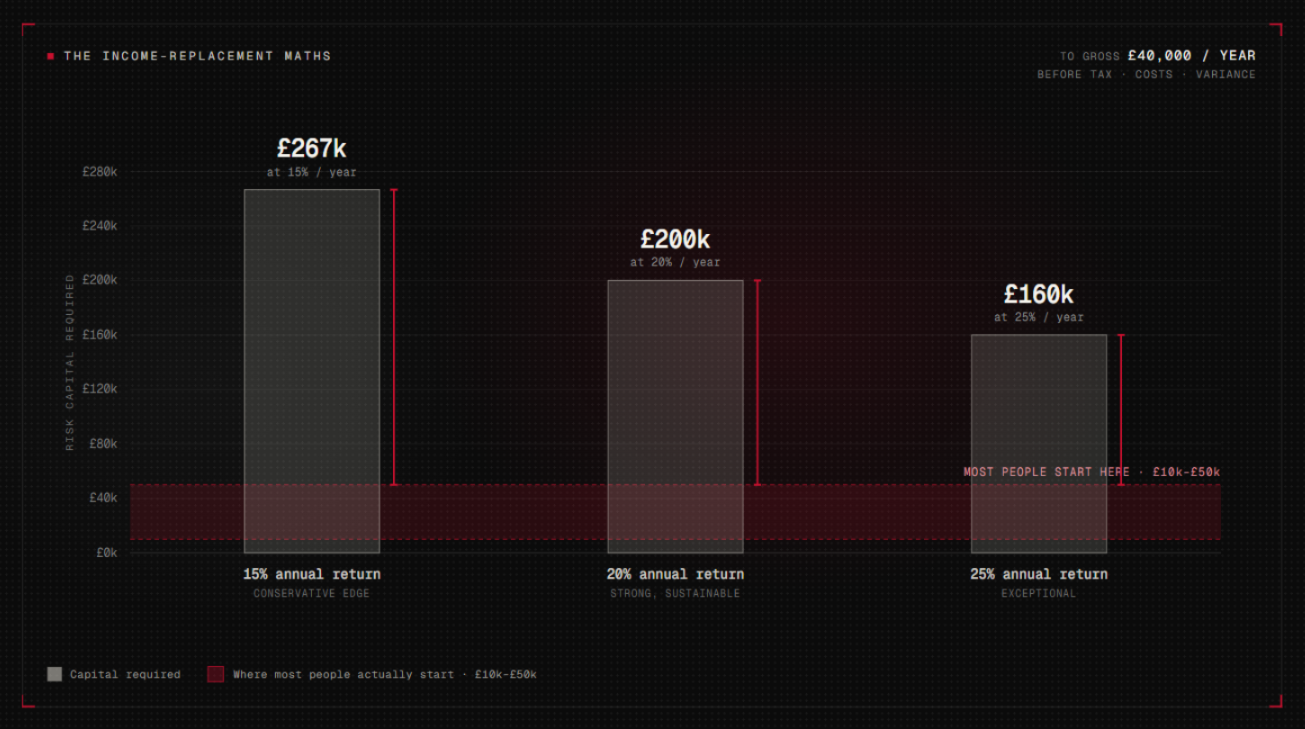
Most people attempting the full-time switch have £10,000 to £50,000. To pull a living wage from capital that size requires returns of 80 to 400% a year, sustained, which means leverage and concentration at levels that eventually destroy the account. The math doesn't care how talented you are. Withdrawing your returns every month also means the account never compounds, so you're permanently stuck on the treadmill at the same capital base.
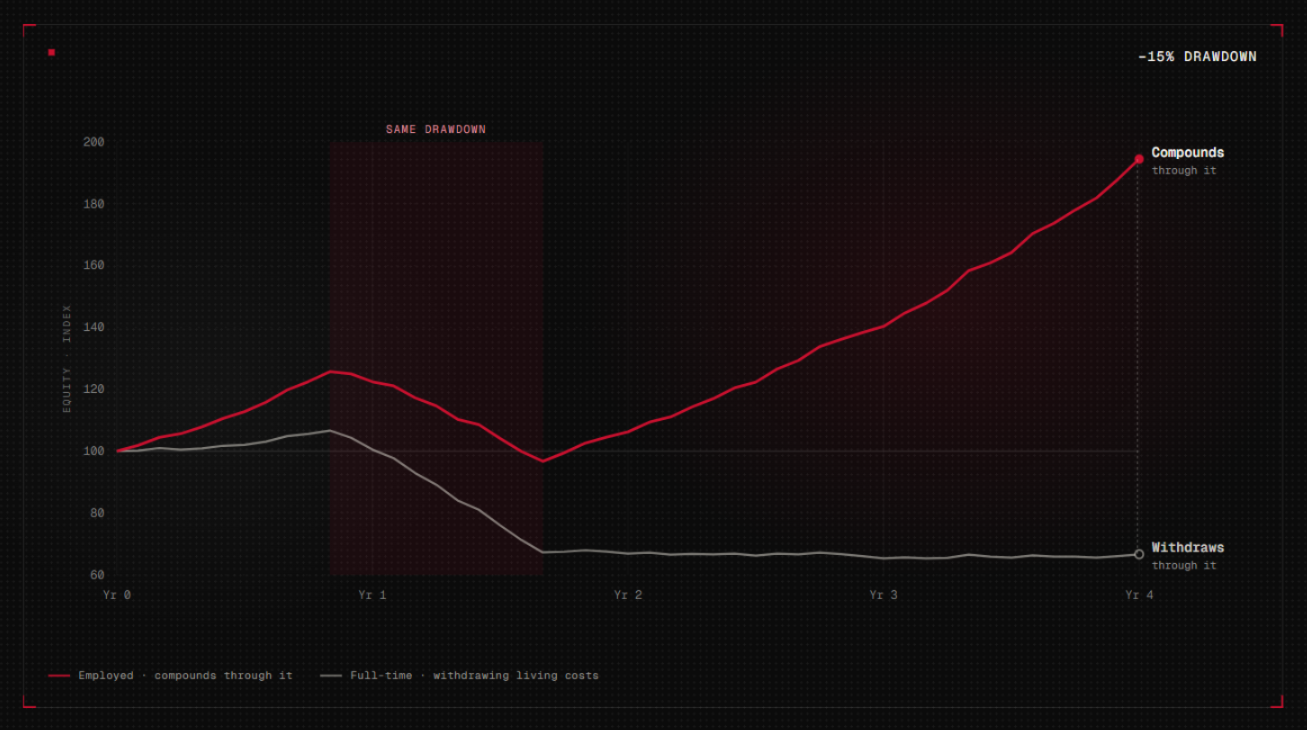
And there's also a more subtle cost: sequencing risk. An employed trader who hits a 15% drawdown in year one keeps compounding through it. A full-time trader who hits the same drawdown while withdrawing living costs digs a hole that the same edge may take years longer to escape, because the withdrawals compound against you exactly when the equity curve is weakest.
The few people for whom full-time trading genuinely works tend to fall into two groups: professionals trading institutional capital for a salary plus bonus, and traders whose accounts are already so large that a modest, sustainable return covers their life with room to spare.
What is the flywheel?
The structure I run instead is simple enough to describe in three sentences. My role at Darwinex pays the bills, every month, regardless of what markets do. XAQP, my systematic portfolio, generates performance fees that I don't need to live on, so they compound into a long-term investment portfolio of equities, metals and crypto. That portfolio raises my standard of living and my future wealth, which takes even more pressure off the other two parts.
Each component protects the others. The salary means I never have to force a trade, so the trading book runs exactly as the backtests intended. The performance fees mean my investing is funded by edge instead of squeezed out of salary savings. The investment portfolio means my long-term wealth doesn't depend on any single month, quarter, or even year of trading performance.
The whole thing only works because the parts are kept separate. What I trade systematically (FX, indices, and metals through CFDs) and what I invest in long-term (equities, metal ETFs and crypto) are different books with different jobs, different time horizons, and different risk budgets. The trading book hunts positive expectancy on a horizon of days. The investment book buys decades.
Most people chase trading as the thing that replaces their job. I think that's the wrong end goal entirely. Trading, for me, is the engine that accelerates everything else.
Why does a salary make you a better trader?
This is the part that took me longest to accept, because it runs against every full-time-trading fantasy I started with.
A salary removes the need for the market to pay you this month. That single change cascades through everything. You can let a drawdown be what your testing said it would be. You can leave the system alone during a flat quarter instead of tinkering the edge out of it. You can decline marginal setups because nothing in your life depends on taking them.
My book currently spends the vast majority of its time flat, out of the market entirely, because the strategies only deploy when their conditions arrive. That structure is only liveable because nothing about my month requires the system to trade more often. An income-dependent trader running the same portfolio would feel every flat week as money not arriving, and the temptation to loosen the entry conditions would grind away at them. Patience is cheap when you're paid elsewhere. Strip the salary away and patience becomes the most expensive thing you own.
There's a career dimension too. Trading rewards people who survive long enough to compound: capital, skill, and reputation all build over years. A salary is what buys you those years. The traders who flame out are so often the ones who put themselves on a clock, where one bad stretch ends the account and the career with it.
The irony of the whole thing: removing the need to make money from trading is the single biggest performance enhancement I ever applied to my trading.
When does going full time actually make sense?
I'm not dogmatic about this. There are realistic versions of the full-time path. It makes sense when at least one of these is true.
You're employed to trade. A fund, a traditional prop shop, a desk. The institution supplies capital, infrastructure, and a salary; the variance of your edge stops being the variance of your bills. This is the version of full-time trading that actually deserves the name professional, and traditional prop shops in particular remain a genuinely good vehicle for scaling serious traders.
Your capital is big enough that a conservative return covers your life with a wide margin. Without a precise threshold, the test is: could a year at half your expected return, inside a 15% drawdown, pass without you changing anything about how you live or trade? If yes, the math has stopped objecting. For most people that implies high six figures of personal risk capital, minimum.
Or trading genuinely is your business in a wider sense. You run external capital, the operation generates fee income, and the structure resembles a small fund more than a person day-trading their savings. At that point you're running a business with diversified revenue, which is a different proposition from trading for rent.
What I'd push back on hard is the version where someone with a five-figure account and a spreadsheet of hope hands in their notice because a YouTuber told them freedom was a funded challenge away. The industry sells that dream relentlessly, and the math above is the reason it keeps not working.
How do I actually run the flywheel day to day?
For the people who like the operational detail, here's the shape of it.
The job comes first in the calendar. I work at Darwinex across growth and business development, and that work funds everything else in my life. The trading is fully automated and systematic, a multi-strategy book across FX, indices, and metals, executing on MetaTrader 5. Automation is what makes the combination possible at all: the system doesn't need me at the screen during work hours, and the strategies were built and stress-tested for exactly that hands-off operation. My job in the trading business is research, robustness testing, and portfolio decisions, which happens in the hours around employment.
Performance fees flow to the investment side on no fixed schedule, into long-term positions I expect to hold for years. Earlier this year that included allocating to a couple of higher-risk thematic ETFs inside my Stocks & Shares ISA as small satellite positions around the core. The investing is deliberately boring. It has to be; its job is to compound, and excitement is what the trading book is for.
Under the current rules, as a UK investor, I prioritise tax-efficient wrappers such as ISAs and a Lifetime ISA where appropriate. The 25% Lifetime ISA government bonus is difficult to ignore if you're eligible.
None of this is a sacrifice while waiting to go full time. This is the end state. The flywheel turning is the goal, because each year it spins, every part of it gets bigger.
Common questions
How much money do you need to trade full time?
Work backwards from your living costs and a sustainable return. Needing £40,000 a year at a realistic 15 to 25% annual return implies roughly £160,000 to £270,000 of risk capital, before tax and variance buffers. Most honest assessments land between four and eight times the annual income you need, plus 2 to 3 years of living expenses in cash.
Can you trade seriously with a full-time job?
Yes, and systematic automation is what makes it work. An automated multi-strategy portfolio executes without you at the screen, so the job and the trading stop competing for the same hours. Research and testing move to evenings and weekends; the system handles the market hours.
Is trading for a living realistic?
For a small minority, under specific conditions: institutional employment, genuinely large personal capital, or a fee-generating fund structure. For an individual planning to pay rent from a five-figure account, the income-replacement math fails before the strategy even gets a chance to.
Should you trade or invest?
Different jobs, both worth doing, kept strictly separate. A trading book hunts short-horizon edge with tight risk control; an investment portfolio compounds over decades. The flywheel structure uses trading profits to fund investing, with a salary underneath so neither is ever forced.
The end goal was never the exit
The full-time trading dream is really a dream about pressure: getting rid of the boss, the alarm, the commute. What I found, living it for three years, was that it swaps those pressures for a worse one, a market that owes you nothing being asked to pay for everything.
Build it the other way round. Let a salary buy your patience. Let your edge compound instead of feeding you. Let the investments turn trading skill into permanent wealth. Trading should complement your life. The moment it has to fund the whole thing, the strategy stops being the strategy.
The flywheel is slower than the dream. It's also still turning.
Personal commentary, not advice. Capital at risk.
Disclosure. Personal commentary, not financial advice. Capital at risk. I am an employee of Darwinex; content touching Darwinex products may represent a conflict of interest, disclosed per MAR Article 20.
XAQP figures are point-in-time as of June 2026 and will change.
Get the next letter in your inbox.
Please consider subscribing to receive more episodes of The Letter.
Subscribe now